Interesting Tidbit

Discovered that you can tell how many views of the blog posting, and WHERE the views originate!  Thought you might find it insightful to see, as well.  I’m truly surprised at the broad reach postings have traveled. Almost 20 countries, including Morocco, Malta, Fiji…. who would have guessed. Over 1500 views in 10 weeks… just incredible. (list at bottom of post)

While Ruminations is focused on a small family farmstead in the USA,

building trust with the cows

and the happenings on the farm and how they relate to the broader picture, I wonder how other cultures/countries view what I have to say.

I know I have friends from other cultures who mourn the loss of their capacity to be in touch with the land & food production. They are working to return those values to “their world”, as well.

It all has to do with localization, I think. That and rebuilding local community.

Waiting for something to happen on the larger scale (government, business, etc) is just NOT going to happen. If its not about making more money, it’s long-term value seems to HAVE no value to them.

So it is up to us, and our neighbors, and our friends… to support our local resources… encourage, nurture, and give that positive feedback.  We have to take back control of quality, enriching the earth, and thinking long-term… it will matter to our children and grandchildren. We can choose to be victims, or we can choose to make a difference, however small it is.

Anyway, hope you continue to follow this journey with me, as we experience “our return” to an “integrated homestead”! Where land, soil, livestock, gardens, all play a part in an ecological cycle that is complete… Where there is no waste… everything, at some point, becomes an input for something else… just as it does in nature.  Mother Earth has spent 4.5 billions years working out this process, and we are only beginning to touch on the subtle relationships that she has developed.

Patiently we watch & listen… and hopefully, learn!

Country Views
United States FlagUnited States 522
Canada FlagCanada 19
United Kingdom FlagUnited Kingdom 14
India FlagIndia 5
Taiwan, Province of China FlagTaiwan 4
Ireland FlagIreland 4
Fiji FlagFiji 4
New Zealand FlagNew Zealand 4
Egypt FlagEgypt 3
Philippines FlagPhilippines 3
Australia FlagAustralia 3
Germany FlagGermany 2
Korea, Republic of FlagRepublic of Korea 2
Morocco FlagMorocco 2
France FlagFrance 2
Bulgaria FlagBulgaria 1
South Africa FlagSouth Africa 1
Malta FlagMalta 1
Turkey FlagTurkey

Throw some mud in the water: Boiling Mad, pt 1

OK, NOW my blood is boiling! The name of the game: Confuse the Consumer.

Erggg… it’s so hard to keep my mouth shut when “data” gets slanted or manipulated… here is my response, in two parts.

When the Western Farm Press (goes out to farmers all over the USA) says to ignore the results of EWG studies done, I have to ask what their interest is. I mean I could say something like:
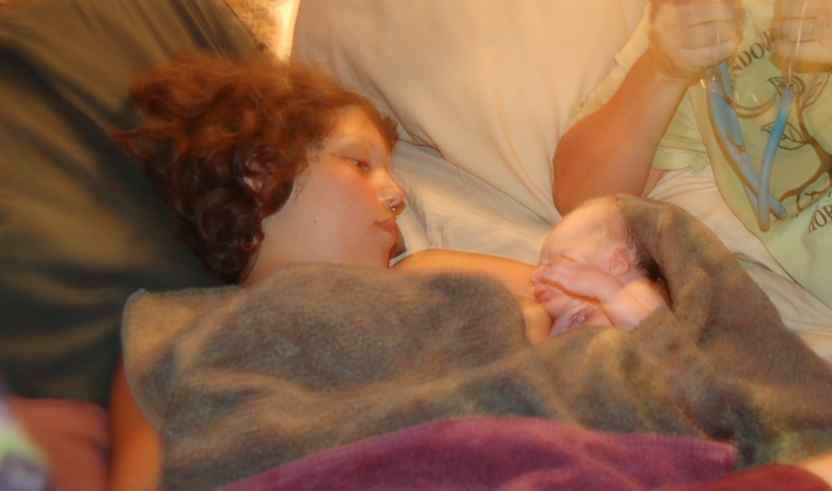
New mom, New babe

“Hey, pregnant mom, don’t take that medication ’cause it might hurt your baby, but here, have some wonderful strawberries.

Oh, by-the-way, they were grown in Chile and are loaded with neurotoxins which are systemically absorbed and can’t be washed off!”

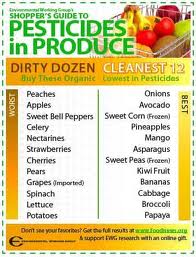
Only, guess what! That is not slanted or manipulated data. It’s well know and the EWG (Environment Working Group) has highlighted those issues in their annual Dirty Dozen report.

Many of you know that I am coming from a background in High Risk Labor & Delivery. From working in the newborn intensive care units, to working with high risk moms (heart problems, diabetics, premature labor, mutilples…twins, triplets, etc), working in family centered units with midwives; in the home, in the clinic, and in the hospital. A fairly broad exposure to the field of Maternal-Child nursing.

Systemically Contaminated Foods

Pieces of the Puzzle - Autism

After 30 years in high risk obstetrical nursing… I have some big concerns about the accumulations of “small” amounts of toxins (pesticides, herbicides, neurotoxins) in our bodies, and in the growing fetus.

I’m concerned about the sky-rocketing rates of autism; from 1/10,000 to 1/100! Yes, one out every 100 babies is diagnosed with autism. And guess what, it’s the middle class and affluent who are experiencing the highest increases.

Do I know that contaminants are directly related? NO, but I worry that it does.

It’s been demonstrated that the “placenta” is NOT a barrier, and what mom takes in, the developing fetus is exposed to, during very critical stages of development.

Toxic effects, know only over time

Most medicine/research advances are made when data is collected RETRO-ACTIVELY, meaning… we look back over time to see what happens. We look at that data, and alter our views.  Short term studies are only good for acute issues (drink a poison, you get an immediate response).

Long-term studies are needed to parse out the real effects.

And I have no desire for my children/grandchildren to be the “test subjects”. “Whoops, we thought it was safe… I think we might have made a slight error”…. Right!

OF course we need to eat fruits and vegetables. It’s the “additives” that I want to stay away from. We do have a choice about the “additives” that find their way into our foods… we can talk with our dollars because that’s the only thing Industrial Ag listens to.

Repeatedly, in medicine and in the industrial corporate world, we are told something is OK, only to find over time, that it was absolutely Incorrect. Because it takes time to get to the real answers… and it’s not the sellers who pay the price, it’s the consumer. You pay both short-term and long-term.

Research & Documenting

We need information, without a vested money interest in the results

I would encourage you to look at the Environmental Working Group website.  I find it balanced, thoughtful, and educational.  Look at how their studies are done.  It is in a very friendly format that is easy to understand (not like those usual dense research reports that I have a hard time wading through).

Look at the FAQ’s: frequently asked questions…. the concerns that other people have had… and the group’s response.  Are their answers dogmatic or rational thinking responses.

I think you can tell pretty quick what a site’s bias is and whether it is based in emotional appeals and/or trying to manipulate you. Or if they are explaining their concerns and giving you the data to make your own decisions.
Good & the Bad Guys

Anything you want, it will get served up… somewhere

I agree… you can find anybody on the web to support any side of any argument, theory, conspiracy, etc. The challenge is to educate ourselves intelligently.

We discuss with our interns, working on the farm, how do you tell when something is true? I mean, you can find info to back up anything you believe… and the tendency is to only look for info that will back up what you WANT to believe.

We’ve gotten some good responses, and two of the best:

  1. when the data is confirmed coming from multiple fields.  From math, from history, from biology…
  2. when you use the information/theory/belief and predict outcomes that are consistently true over time
I would enjoy hearing your opinion on this issue. I’d like to know if others share the same concerns.
  • are you aware of the residual chemicals that can not be removed by washing, on your food?
  • do you ever think it’s important, for safety reasons, to choose american vrs imported?
  • did you know about the dramatic rise in autism rates?
  • have you changed your buying patterns once you  became more aware?
  • does your pediatrician ever say anything about organic foods?
Please use the comment section to respond… it would be great to hear everyone’s experiences or thoughts!

Back to the Basics
Eat Healthy, Eat Local, Eat Quality
This is such an awesome post (and it’s comments!). I think it speaks to what matters in life… relationships, not things. Let me know what YOU think!

Something different…

If we look at our history, and I mean real history, not just the last 10,000 years, we can see how changes have affected our physical make-up. Why the obesity epidemic has occurred. We can see how the draconian changes in the last 50 years in our food systems, have dramatically altered the impact food, or rather food-like substances, on our bodies.

The Real Food Revolution is a medically backed clip on some food issues I have suspected for years. The science is finally developed enough (and clear of the politically/corporate influence) to provide some real data.

Take a close look at that last figure on the graph… it’s all happened in less than 50 years!

Dr. Lustig, out of UC SF, has published around the same topic. His presentation is a bit heavier on the science, but very, very watchable. He has a great sense of humor which probably explains why it has had over 3 million hits, and continues to grow; Sugar, The Bitter Truth. In his talk he includes a discussion on the toxic effects of “high fructose corn syrup”.

The Turkey and the Hen, pt 1

You can check back and read the first post on this little adventure, A Surrogate Mother, if you want more background info.  At this point we have a turkey hen who STILL wants to lay her eggs and sit on them.

Sitting on them long enough, is the real issue.  She does very well for a few days and then will leave.  Those eggs need to be kept pretty consistent at 99.8 degrees F to actually hatch, for 28 days. I mean, I’m sure they can tolerate some lower temps, when mom goes to eat/drink… but they cannot end up being stone cold before she gets back.

ERGO, my broody hen was called in to help out. She, who is content to “sit”, almost forever (one time for close to 60 days).  That time we brought HER food and water to make sure she was getting enough, she was so dedicated to her egg-sitting.

As I mentioned in the earlier post, we took the hen’s eggs that she was sitting on and put them in the incubator.  We took the turkey eggs and put them under the hen.  Turkey chicks are pretty fragile and do much better being raised by a hen, then by ME.

Now, the latest. This Midget White Turkey is obsessed.  She keeps wanting to sit on some eggs.. but unfortunately, she’s not exactly dedicated to the job.  She also likes to “flirt” with the guys… so will take off, forgetting all about her eggs.  When she remembers and heads back to the nest… she looks around for the eggs.

Bunk-bed sitting hens

On discovering that the HEN had eggs, she promptly set on the hen. I mean, actually climbed on top of the hen, and was sitting on her. Our broody hen would NOT budge. (did I mention the word dedicated????).

They did finally share side by side, with each keeping eggs warm. I hope the embryo’s are pretty sturdy to handle all the “action” they have been getting.

The turkey’s last visit back to the sitting area, she created a new nest and laid more eggs. Now we have way too many eggs for that little hen to sit on, plus the timing was going to be all off.

We took these newest turkey eggs, marked them, and put them in the incubator, to see if we could save them.  Maybe I’ll have another hen go broody (we’re certainly having spring like weather)… and can slip them under her before they hatch, and she can raise them.

Playtime, on the farm!

Niki caught this shot of Mick & the calf racing across the field…

Predators have 2 eyes in front!

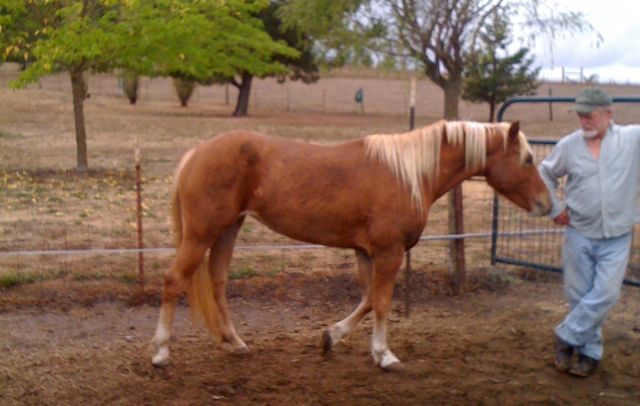
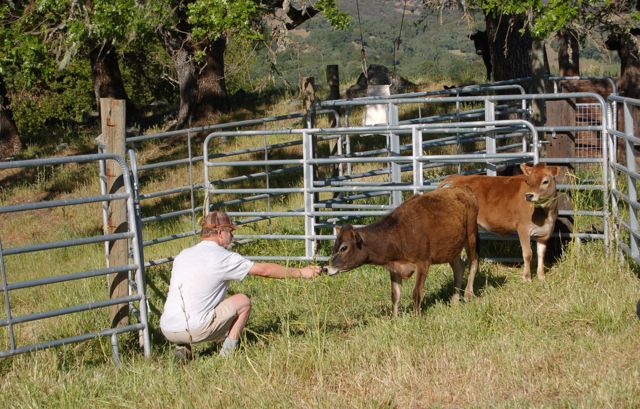
When people visit the farm one of the first things we talk about, before seeing the livestock, is how to interact with our cows and horses (& mini-horses).  We bred for temperament so we start out with fairly mellow livestock… but it’s important to understand where they, genetically, are coming from to avoid triggering survival instincts.

First Day on the Farm - Lady comes to Jim

These animals have historically been prey, i.e. food. They have developed some pretty strong instincts that allow them to survive in the wild. Animals (predators) that hunt them down have two eyes, that work together in front, that will stare at them!

Prey (future dinner meal) animals have eyes that look to the side and each eye actually works independently. One eye can look behind and the other can look ahead… almost 360 degree vision. AMAZING.  Their brains can make some sense out of this information. Safety & survival.

If your eyes are in front, you can’t see behind you or to the side very well, without turning your head.  But two eyes working together are better at judging distance, when you are in attack mode!

We had a cow who, I swear had surround vision! She could, with one eye, watch her food, and with the other eye, wait until we were in kicking range while milking. Grrr-r-r-r.

Predators also reach out with a stretched out open paw, claws extended, to attack. Guess what people automatically do? Reach up and out with extended fingers, to touch livestock on the head.

Prey animals are very sensitive to certain movements that humans make so we try to decrease their stress by encouraging visitors to do several things. Our goal is to make “socializing” positive for both sides, human and animal.

Methods:

One, don’t look directly at the animal (with both eyes) until they have been introduced to you. When

Don't Look DIRECTLY

looking directly at them (with both eyes) look away occasionally, to take the stress off them. I’ll turn my head slightly, so they can only see one eye.

I still do this with a “new mom” as she may be extra nervous with a newborn calf at her side.

Two, don’t reach up and out with an open hand, to touch the animal.  Put your hand out down low, with the back of your hand showing (fingers tucked away)… and let the animal reach out to you and sniff your hand.  THEN you can turn your hand over, and touch them. They can be incredibly sensitive & gentle with their muzzles.

Three, talk quietly, slowly, and in low tones. High pitched tones come from bobcats, etc!

Four, move slowly, and give them time to adjust to where you are moving to. ALWAYS let them know, quietly, if you are directly behind them to avoid spooking them. (They cannot see directly behind themselves.) FAST movements are perceived as a threat (predator after them).

Using these techniques works well.  The other interesting thing.. you don’t actually have to go directly up to the animal.  If you stand or sit still, they will come to you. They are incredibly curious and as long as they don’t perceive you as a threat… they will want to meet YOU.

Teasing Chocolate… being a bad boy!

Our Cocker Spaniel, Mick, loves to play with the new calf.  He thinks it’s HIS new playmate.  But mom has other ideas.  Because Mick has front eyes, moves quickly, and makes “attack” movements, she see’s him as a threat to her baby (despite knowing him since he was born!).

He’s making a nervous wreak out of our new mom. Poor Mick… he get’s put on a leash so that he will NOT tease Chocolate.  He’s only allowed to go out “under supervision”!

Newborn calf doing well!

Our area got hit with over 6 inches of rain!!! It quickly creates a river that runs between the house and the barn, and pools into a shallow lake in the pasture.  We’re quite lucky that the pasture area drains fairly quickly.  Despite it being winter this was a relatively warm storm.  No freezing temperatures.

Glad that our newborn calf had a few days of warm, dry weather before the start of the rains.  He handled the change in weather without a hitch.  Kicking up his heels and playing…. instead of curled up in a miserable lump as I fantasized.  It’s a pretty human characteristic, to super-impose our reactions onto animals.

Barns are mostly for people… for storing items like tools, hay, feed, etc. We don’t use the barn for our livestock. Overall, it’s not healthy for them.  Cows, horses, etc. prefer the outdoors and tend to choose a tree or windbreaks for their shelter.  Livestock closed up in a barn are at risk for respiratory problems… the build-up of manure and urine produces fumes that are irritating to their lungs. They have survived for tens of thousands of years… outside.

Well, except for our chickens who are closed up inside the barn at night, but only because it was a convenient place to put an enclosed cage to protect them from predators. Not that THEY needed the barn. It could be in a chicken tractor, outside. Now, our weather here in coastal california is rather mild.

We don’t have drifts of snow for livestock to dig through, looking for food and water.  Instead our chickens, turkeys and guinea hens roam freely, except at night, where we have closed down The Heritage Barn Chicken Buffet that a Red Fox, last year, helped himself to.

The calf did not miss a beat… he frolicked and played in the rain. His coat is thick and water-resistant, seemingly untouched by the steady rain.  We had three days, off and on, of rain.

halter, calf, train

Halter Training

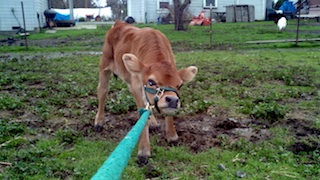
Of course, then it came to the time to put a halter on the calf and get him used to being led around.  You can see from the picture how excited he was about this new adventure. He actually acclimated rather quickly and our intern was able to led him around the pasture.

Niki, our intern, also discovered the easiest time to put the halter ON.  When the calf was napping!

They are almost dead to the world.  You can do just about anything to them and they don’t wake up.  And mom has usually parked the calf, for his nap, and she’s gone off to eat so she’s not there to run interference in putting a halter on her baby.

We’ll try to lead him around a short while each day… and spend time with him, socializing.

Then he is let off the lead rope, races over to mom, and get’s a comforting drink of milk!

Fish talk…

It’s pretty cool… being able to put one’s thoughts down but really, there should be a point to it all.  One of the most frustrating  things I keep running into is LOOSING interesting info that I want to share. So, I need a place to “place” all those “goodies” that I can refer other’s to if they have an interest in what we are discussing.

It would be excellent to have a place where other people can suggest interesting things to look at. So please bear with me while I figure out how to do this… and if you have any hints or suggestions on how to do it, post it!!!

Just to start, I find an excellent TED-talk to check out is a humorous introduction to the problem of how to keep fish on our menus.  How I Fell In Love With A Fish. It’s less than a 20 min clip and worth the time to view it.

At some point I’m guessing there will be a place to actually PUT interesting links, rather than in the middle of a blog posting.  Something on a side column.  I’ll check it out.

Newer entries »