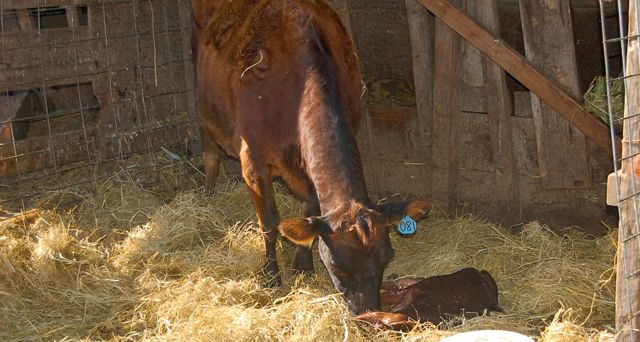
Calf delivery..lots of pics, graphic

We were getting a bit worried that the calf had not been born yet, the weather forecast was calling for rain, in a few days.  All these warm, sunny days had been perfect for a newborn but we were going to lose that window.

But Jim came in from his morning rounds to tell me to get ready…                                camera, coffee, and coat!  Chocolate was pacing around the pasture.
early labor? pacing

Pacing around the pasture

She moved behind the trailer, behind the truck, behind the barn. Never staying long, and not eating… early contractions? She kept lifting her tail head. More mucus discharge.
Bessie watching out for Chocolate

Bessie keeps a close eye on Chocolate

Bessie was following a short distance, keeping her company the whole way.  The neighbors cows came over to stand by the fence, watching her carefully.

If you didn’t know, birthing time is of great interest to all the other livestock!  Often they come peek around the corner to see what is happening.

Chocolate finally chose to go into the barn paddock stall.  Jim closed her in so she would have a protected area to move around in.

Paddock where Chocolate settled

Paddock for the delivery area

Our intern carefully spread fresh straw down so that the calf would have a “soft landing”.  Two interns had just finished mucking the stall area out the day before… . perfect timing.

Our boar hog in the next pen kept watching and pacing, quite curious about what was going on.

Jim made a few phone calls to alert neighbors that the big event would actually be happening!
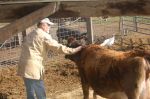
Early active labor

Jim gives some TLC to Chocolate

This Jersey birth was quite strikingly different from our lowline angus beef cows.  Much longer process, 1 1/2 hr.  But it makes sense.  Beef cows tend to be out on rangeland, or large pastures.  They are at risk for predator attacks.  They don’t have the luxury of a longish labor.  Those livestock would be dead and their genes NOT passed on.

Beef cows do what I call, “The Stop and Drop”!

Milk cows have been domesticated for thousands of years.  In a protected environment those quick genes were not quite as critical.

Chocolate got up & down, moved around between contractions.
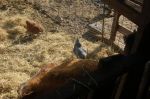
laboring & the chickens stop by for a visit!

Chickens drop by, as Chocolate labors

She finally chose to lay down and completed her labor in that position.  She would thrust her upper rear leg out as she had a contraction and slowly began to push. Nothing to see… just a contraction, a push, and then she would stop and chew her cud for a few minutes.

The important thing is to remember to stay out-of-the-way! Let nature take it’s course.

And finally, she began to push and I had the delicate job of explaining why seeing poop was a GOOD sign.  That as the calf moved through the birth canal, the rectum runs above the birth canal.  As the calf move through and out, it was also pushing out any stool left in the rectum… it meant we were getting very, very close.
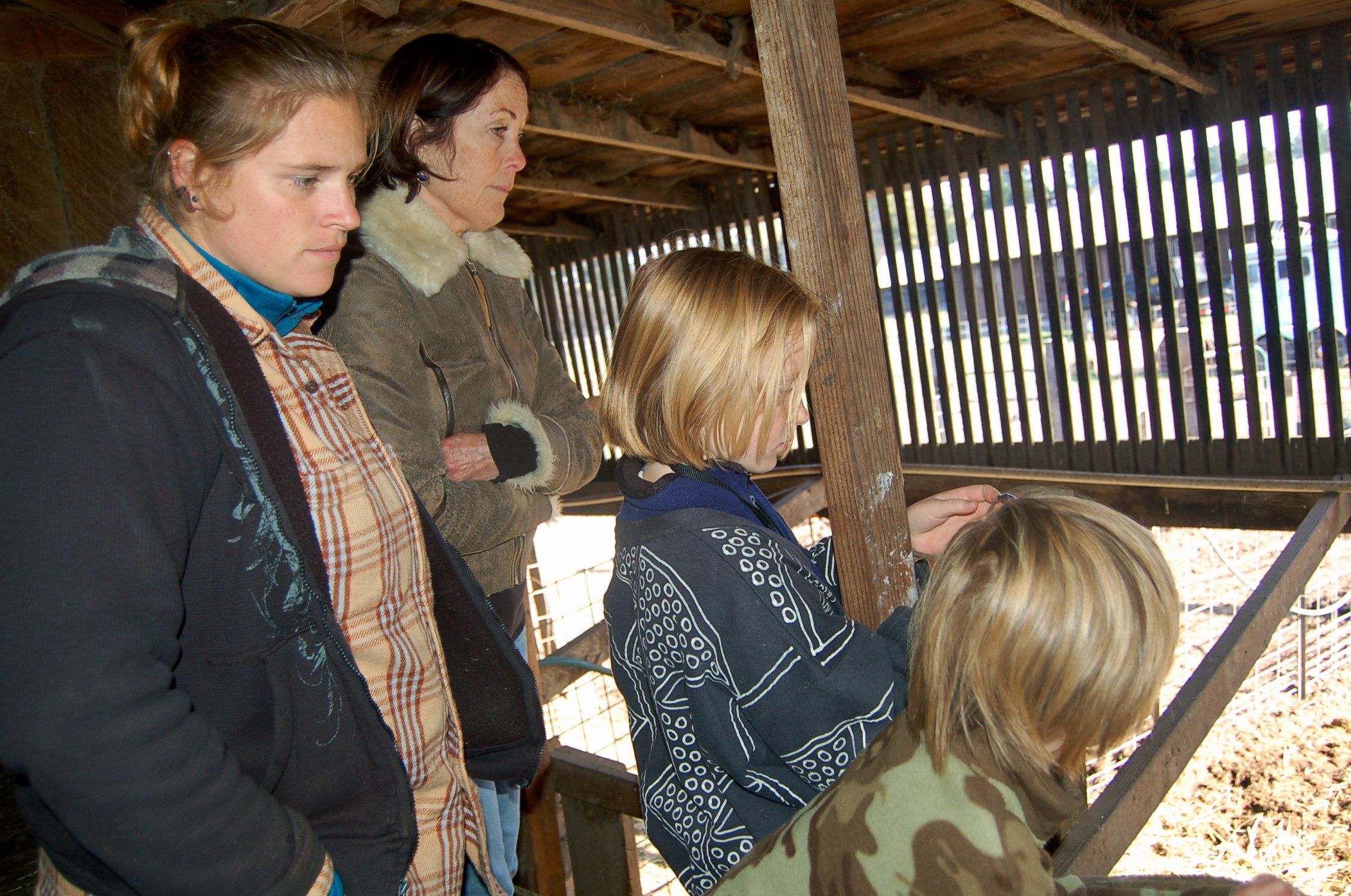
some of the observers...

Watching the delivery, from the barn

It was an awesome experience (we had from age 6 – 60 watching).  I think birth is one of the most mesmerizing things to watch.  Our barn setup is excellent because one side is open to the lower stalls.  It’s for ease of taking the hay stored in the barn, and being able to toss it into the feeders, just below.  Perfect viewing platform to be OUT of the way and yet see what was going on.

It’s time!

All of a sudden, more mucus, a tinge of blood, and then a bubble emerging… the bag of waters.
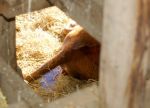
white filmy membrane, bag of waters broken

Bag of waters broken, finally

Under the pressure, it suddenly burst. Clear fluid and the path was lubricated for the calf.

Next contraction and we were seeing a tiny hoof peek out and then pull back.
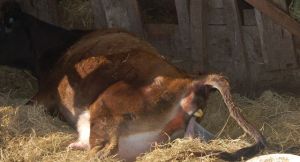
a hoof, at the birth canal

First sight of a hoof

Over the next few contractions, we would see more of the hoof and then finally a 2nd hoof… a good sign.

Calf was in a good position (only one hoof might mean a leg twisted back that would impede the delivery).

two hooves showing

Two hooves showing!

Beautifully, the beginnings of the muzzle appeared. Perfect position for an uncomplicated delivery.
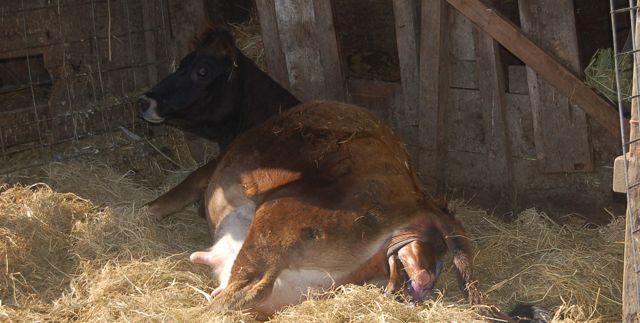
calf's muzzle

The beginning of the calf's muzzle are showing

Another contraction and the head was through.  Amazingly, the calf shook its head… long ears flopping.
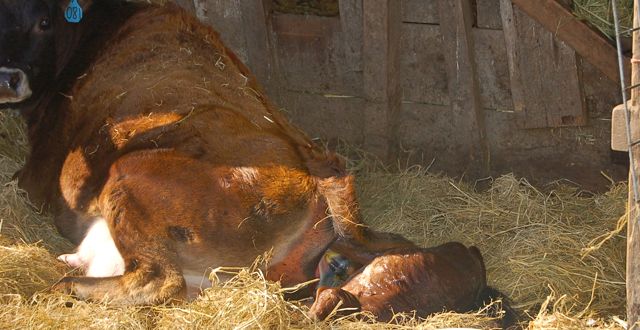
Delivery Done!

Birth is complete!

Over the course of a couple of contractions the calf’s body slipped through, and suddenly he was there.

Breath held we waited, waited to see him actively take a real breath.  No active movement, but watching carefully you could see his ribs rise and fall.  But at first, no movement… scary.

Two of us nurses, again, having to fight the impulse to jump in, and stimulate the calf to breath, to rub it dry. Instead, having to just watch.
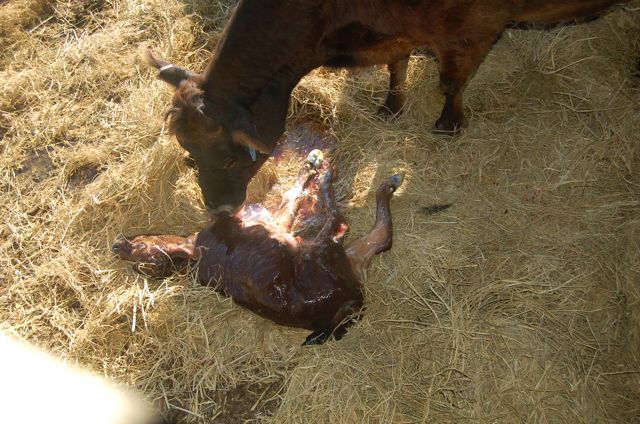
Laying perfectly still...

Is the calf OK, He's so still?

Amazingly, Chocolate immediately got up and started lick her calf… vigorously.

This flaccid little limp frame of a calf was a little scary.  Was he normal? He looked like skin and bones.  But the more his mother licked him, the more active he became… and the healthier he started looking!

Finally, I breathe a sigh of relief when see him lift his head, a spontaneous movement on his part.  He’ll be fine.
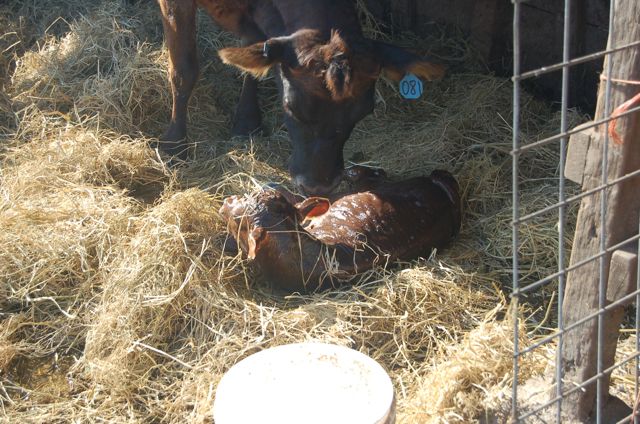
the calf begins to move!

The Calf begins to move!

stimulating by licking

Mom is quite vigorous at the licking!

His soft white hoofs were hardening up now that they were exposed to air.

At birth, they are soft & pliable.  Think of fingernails after washing dishes or taking a bath.  Makes sense, cause a sharp hoof could lacerate the bag of waters or the uterus or the birth canal.  He did not even try to stand for the first 30 minutes, but the hoofs were quickly firming up.
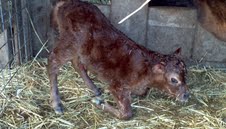
He begins to stand

Attempting to get his balance & stand

His little legs spayed out as he would try to stand… from legs slipping away from him; ok, try the back legs… same thing.  But wait, rest, and try again… all the while mom is licking him so vigorously she knocks him around a bit.  She’s cleaning, drying him off, getting the “birth smell” removed so he will not be a target for predators. Her instinctual behavior is amazing to watch.
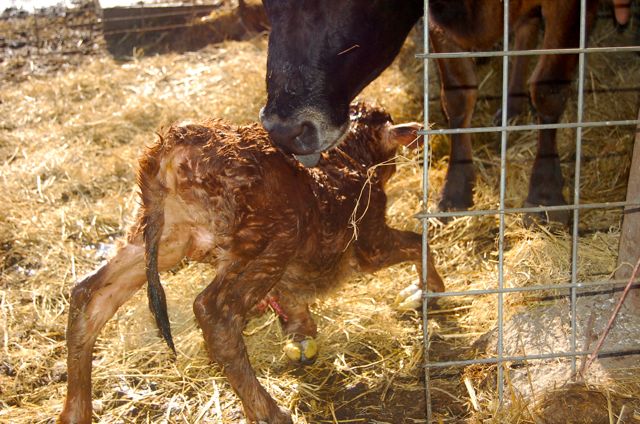
almost up on all four feet

Almost Up!

He finally gets a bit more control and is able to stand, taking his first wobbly steps, he actually begins to explore the world around him. Amazing curiosity.

Jim approaches the calf, carefully. The calf IS curious and wobbles over to him.
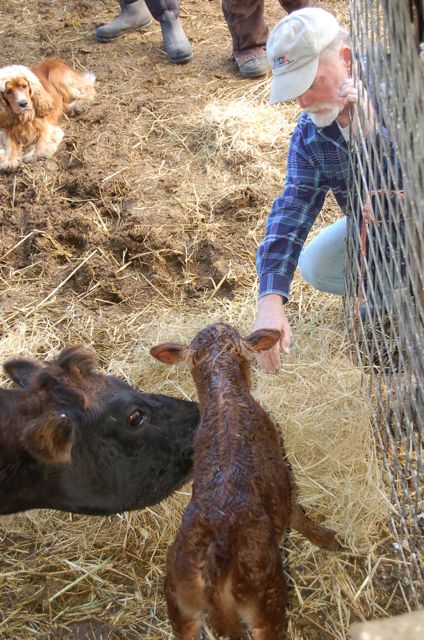
Calf checking out Jim

Who's that stranger???

Mom isn’t to sure.  She lets out a mooooo-o-o.  Jim stays very still and just holds his hand out for the calf to sniff.  Mom is OK with this.

And then the calf decides to take off and explore the rest of the paddock… our visitors have moved the back area of the ground floor paddock so that they could see what was happening.
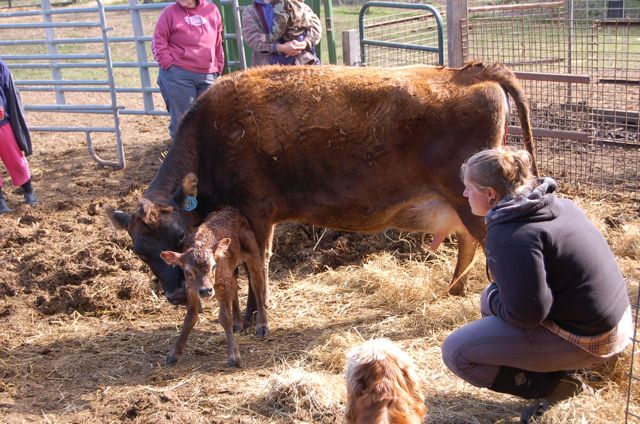
A world to explore

The Calf take off to explore!

The calf takes off to check these new creatures.

WHOOOPS, I’m thinking we might be in trouble with mom... but no, as long as we stay still, and the calf does the approach she is OK with this.

We had a great groups of folks who moved slowly and quietly… did not bother mom at all.

 She just follows him, still getting a lick in when she can! He is beginning to dry and fluff up… getting that cute fawn look to him, with those big eyes staring at you.

The next big step… for him is nursing. He needs to get that first milk, the colostrum, in his gut before the first 6 hrs are up.
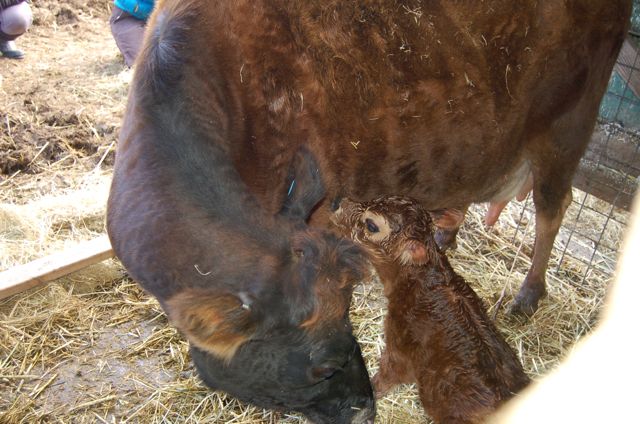
Calf looking for the teat

Beginnings of the search for the Teat

But he’s got time.  Born at 11:30 and exploring the world by 12. Now that is some action.

It will actually be another hour before he is able to find and latch onto the teat… again, much slower than beef calves.

Dried off and his fur fluffed up, he is so soft to touch. a gentle calm little creature.  He’ll be a great addition to our farm stead. He’s turning a light golden color… Hmm, now a name?

And at the end of his first exploration… he collapses… and takes a nap.
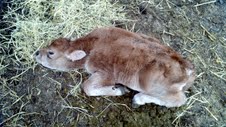
Napping

Getting ready to Nap!

This slideshow requires JavaScript.

It’s a Boy! An Old World Jersey fullblood…

This slideshow requires JavaScript.

I’ll fill you on the story… when we get all the work done, that we put off for “the birth”!

No Calf, yet….

You’ve heard of the watched pot! Well, we’re walking over to neighbors for dinner… maybe she’ll decide the pressure is off and will go ahead and do the deed.  Actually, her due date is Jan 19th! But really, I can’t believe she will hold on that long though.

Udderly dysfunctional… for a calf

A few pics of udders that might have some problems!

these are NOT our cows, but you can see a few pictures of problem udders when cows are bred for increased volumes of milk. A calf would have significant difficulty nursing from one of these udders.  The first udder would be difficult but could be done if she were shown repeatedly, where to go for the milk.

Today’s calves still “search” much higher up, where the udder were traditionally.  That’s why the high udder on our old world jersey is where the calf will located it easily, by instinct. Read the rest of this entry »

How to tell when it “time” to calve…

Yesterday I was saying that Chocolate is close to dropping her calf (i.e. birthing)… so a few other hints that it is getting close.  Her udder (bag) has filled out! She doesn’t have the huge bag of a standard Jersey, or the ground dragging bags of Holsteins. So when you notice her udder… it means something is going on, as well as when the teats lengthen and start to look full.

The temps dropped to the high 20’s last night… so glad our cows tend to deliver in the daytime when the temps have warmed up.  Chocolate’s udder looks fuller today, and the teats are beginning to angle OUT (the better for a newborn calf to find). And even better some of the teats are beginning to show drops of milk… dripping out.

This slideshow requires JavaScript.

When the calf is born, and starts looking for a teat, it is so funny to see.  The teats will just be streaming milk.

Read the rest of this entry »

Chocolate getting close to delivery

Warning: there are some graphic pictures of real life, in the slide show!

When a cow is close to delivery her bag will begin to fill up with milk, her teats lengthen, and mucus will show-up on her perineum.  Her very full belly was low to the ground and looking very wide, NOW looks less full. The calf has moved up and back.

The calf has moved into position, to the birth canal. The ligaments around the birth canal have softened so they can stretch and let the calf through. We moved Chocolate to the big pasture so she will have room to move around and to choose her birth place. The other cows will provide security and protection for her.  The birth, when it happens, tends to occur fairly quickly.  Smaller breeds of cows don’t have the birthing issues of the large breeds.

Chocolate is an old world jersey… closer in heritage to the original stock that was brought over in ships when the english colonized the american colonies.  They came

This slideshow requires JavaScript.

from the Isle of Jersey (southern tip of the english isle). They are currently at risk for being lost, as their numbers are so small.  Most Jerseys were bred up in size so that they would produce more milk.

Chocolate is just a few inches shorter than our standard Jersey, Bessie, but she looks fuller in body. Standard jerseys have a more boney look to them, while the old world’s still have some “meat” on their bones.  They don’t give us much milk, but for a small family farm, that is just fine.  Our OW Jersey will live for 20 years, a jersey in an industrial dairy has a life span of 4 years, usually. We are after quality, longevity, and health… and give up “volumes” of milk, for that tradeoff. We also choose to milk once a day, which puts less demand on the cow.

We want to use Chocolate for breeding more OWJerseys because she is naturally polled (i.e. no horns), she has an excellent temperament, and gives good milk. She never gets sick (no mastitis, infection in the udder, which is a reoccurring problem in standard jerseys). We don’t want to lose the older genetics.  While she will not give as much milk, the milk she does give is high in butterfat… i.e. will make good butter, cheese, & other milk products.

Two-Income Trap…

This talk by Elizabeth Warren is an excellent overview, done in March of 2007, of what has happened to the American Middle Class.  She follows the development of the changes in middle class american from WWII, up until 2007.

It’s especially pertinent because the “progress” we thought we were making had some subtle traps that created rather unexpected results.  This youtube presentation, through the Univ of Calif channel, starts off a bit slow with intro but after the first 4 min, it quickly kicks into high gear.

Warren’s research into the causes of bankruptcy shoots down many commonly held beliefs and shows how we are especially vulnerable.  Note that this talk was done BEFORE the economic stresses of 2008.

 http://www.cosmolearning.com/videos/elizabeth-warren-the-collapse-of-the-middle-class/

Her contention that adding the 2nd income triggers unexpected fixed costs (example: moves you into a higher tax bracket), leaves you less resilient (i.e. fewer options) to deal with changes that WILL happen in your life. I would suggest that there were even more repercussions, significant ones, than she brings up.  But first, take a look at what Warren has to say… map out an hour to watch this!

Fish talk…

It’s pretty cool… being able to put one’s thoughts down but really, there should be a point to it all.  One of the most frustrating  things I keep running into is LOOSING interesting info that I want to share. So, I need a place to “place” all those “goodies” that I can refer other’s to if they have an interest in what we are discussing.

It would be excellent to have a place where other people can suggest interesting things to look at. So please bear with me while I figure out how to do this… and if you have any hints or suggestions on how to do it, post it!!!

Just to start, I find an excellent TED-talk to check out is a humorous introduction to the problem of how to keep fish on our menus.  How I Fell In Love With A Fish. It’s less than a 20 min clip and worth the time to view it.

At some point I’m guessing there will be a place to actually PUT interesting links, rather than in the middle of a blog posting.  Something on a side column.  I’ll check it out.

from The Heritage Farm…

Ruminations from The Heritage Farm… Something I do, as well as the cows on our farm, ruminate.

We started farming, with real live livestock, less than five years ago.  Turns out that cows are ruminate animals… they have four stomachs, each very specialized. They eat grass/forage and send it off to the first stomach where they have some handy little helpers known as “microbes” that begin to break down the cellulose in the food.  It’s just too tough for cows to digest by themselves.  Instead, they sit a spell… chewing their cud.

The first stomach, called the rumen, is a holding area where the microbes get started with their work.  Then, in a very “earthy” fashion, the cow coughs up a bit and chews it, over and over, until it is broken down enough to send it on to the other stomachs.  There the nutrients and energy are retrieved and utilized by the cow. It strikes me, in a strange fashion, that I also ruminate.

Often, I hear/read something that just doesn’t sit right.  I can’t take it at face value and send it on its way. It bugs the heck out of me.  Sits there like a big lump waiting to be dissected until the parts begin to make sense of the “whole”.   Instead I need to take some time and turn it over and over in my head until it begins to make sense, and make sense applied in the real world. I ruminate, break it down and work it over, until I can pull all the good stuff out of it and use it to make sense of the world unfolding around me.

chewing her cud

If you care to hear about some of the results of those “ruminations” check in occasionally,

or sign up for an email when something gets posted.  It might be interesting to share our thoughts,  as well!

It should be an interesting trip… and perhaps useful in a tangible way.

Rumination in action!

Before cows ruminate, they must first eat some food… hay, pasture, forage (leaves, stalks, etc).


Actually, cattle have one stomach with four compartments.

4 different compartments

Cow Stomach with 4 compartments

They are the rumenreticulumomasum, and abomasum, with the rumen being the largest compartment.The reticulum, the smallest compartment, is known as the “honeycomb”.

Cattle sometimes consume metal objects which are deposited in the reticulum and irritation from the metal objects causes hardware disease.

The omasum’s main function is to absorb water and nutrients from the digestible feed. The omasum is known as the “many plies”.

The abomasum is like the human stomach; this is why it is known as the “true stomach”.

Cattle are ruminants, meaning that they have a digestive system that allows use of otherwise indigestible foods by regurgitating and rechewing them as “cud”. The cud is then reswallowed and further digested by specialisedmicroorganisms in the rumen. These microbes are primarily responsible for decomposing cellulose and other carbohydrates into volatile fatty acids that cattle use as their primary metabolic fuel.

The microbes inside the rumen are also able to synthesize amino acids from non-protein nitrogenous sources, such as urea and ammonia. As these microbes reproduce in the rumen, older generations die and their carcasses continue on through the digestive tract. These carcasses are then partially digested by the cattle, allowing them to gain a high quality protein source.

These features allow cattle to thrive on grassesand other vegetation.

Newer entries »