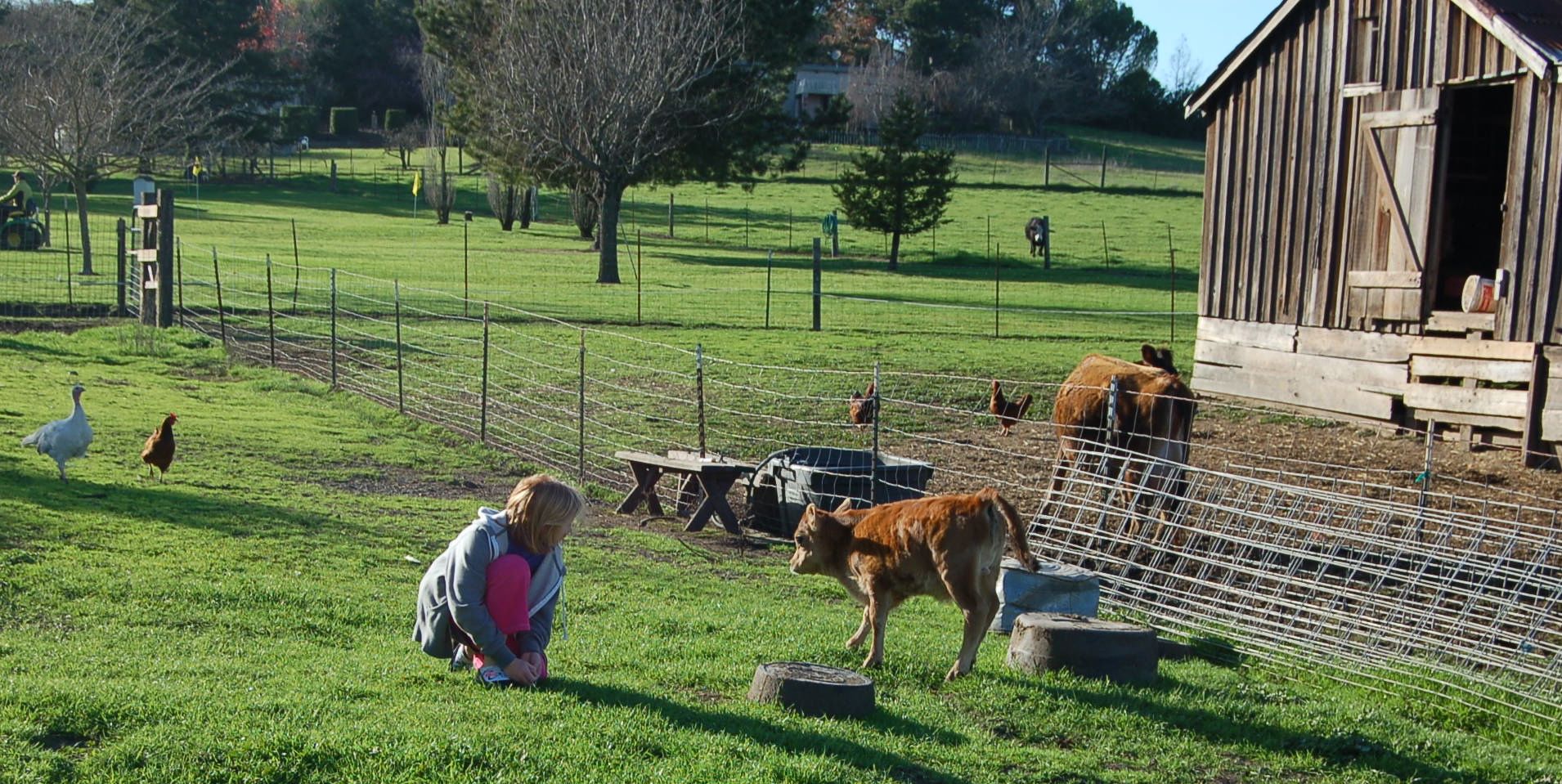
Cocoa’s introduction to milking…

It’s always an unknown, how a cow will respond to being milked.

When I think of a milking cow, I see a picture in my head. It’s of a mellow cow slowly moving to the milking trailer, browsing around inside the head stall, searching out her treats & munching away on a bits of hay
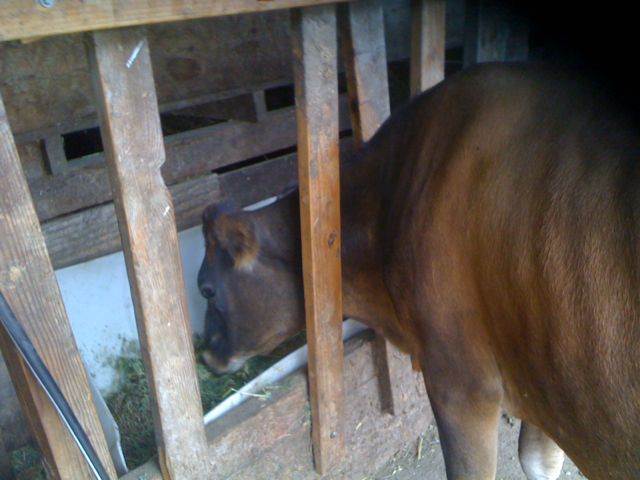
Extra fine hay & a bit of grain

while she stands patiently, and is milked. I don’t even need to lock her into the headstall to prevent her from backing up.

She knows, and is comfortable with the whole routine.  It’s an expected part of the day. If I don’t come soon enough, she will stand at the gate waiting for me, with large patient eyes. No fuss, no mooing, no impatience… she just “waits”.

I open the gate, and she marches right in.  I don’t even need to put up a paneled run to make sure she doesn’t “escape” and go somewhere else.  She knows right where she wants to go, and we are on the same page.

A Different Kettle of Fish

But now, a brand-new cow to milking, is whole different kettle of fish.  As I’ve mentioned before, we like to leave the calves on their mom’s full-time for the first few weeks, and then we will start to share milk with the calf, milking once a day. She has recovered from the birth and bonded with her newborn. (In the industry, she would never see her calf again, after the delivery.)

I run through my head of all the possible “problems” and things I need to get ready “just in case” we run into one of those problems. She could be frightened of the milking trailer… you go from bright sunshine into a shadowy area; it’s spooky to a cow.  The smells should be OK… calm cows have been in there before her so have not left the “scent” of fear/anxiety/stress.  (Under stress a cow will shoot out a VERY icky, smelly, liquid poop! guaranteed to tell the next cow, DANGER).

Competition & other misc matters…
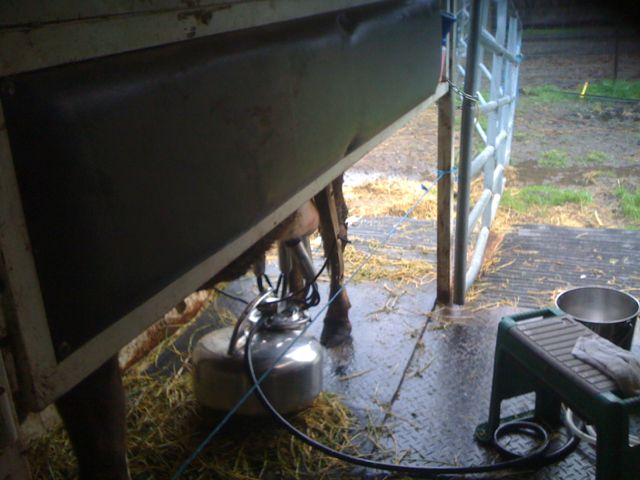
Panels confine the space, for milking in the protected trailer

She might not like the confined feeling of the trailer, or she may not like the hen who is trying to nest in her food/hay in the head stall (a BIG problem… I have no idea why the hens seem to think that is the optimal place to lay their eggs)!

I have even seen a hen squawk so much, when her “laying time” is getting interrupted that Bessie will back out and WAIT until the hen is done!

Quite funny to see a 7 lb hen, dictate timing to a 1000 lb milk cow!

And then the big problem that must be ready for… what if she’s a kicker? or a tale swisher.  We’ve had a cow before that would just wait (and remember… they can keep one eye on you AND one eye on their food, AT THE SAME TIME)…until you are in position and let loose a kick or swatch your face with her tail. (Oh yes, they can hit a fly at 30 paces, I swear! they are so accurate with that tail). Heaven help you if that tail is a bit yucky with manure… ’cause you are sure to wear it, if she’s that kind of girl! 

Our 9 yr old standard Jersey…  Bessie is as mellow as they come, and she is a treasure to work with… very, very good for beginners to start with. But like I said, a new cow is just unknown territory.

A beef cow… you can’t get anywhere near their udder… unless you have them locked down in a squeeze chute where they absolutely can’t get away from you.  Amazingly… they never have ANY problems with their udders… tiny, petite, and absolutely functional ’cause their calves grow like weeds. At least, that is our experience with our Lowline Angus… great moms & healthy calves.

Breeding Stock for small family farms…

Because we are working on developing stock for the small farm, we decided to branch out a bit from the traditional milk cow and beef cow.  Each have been bred for a specific purpose and if you have lots of room, they are generally your best bet to utilize.

If I want a beef cow to give milk… I’ll probably have to give up milk quantity.  If I want a milk cow to be good for meat… I will probably have to give up high-end quality  meat (i.e. tenderness & taste).   It will still be good, just not 5 star rated!
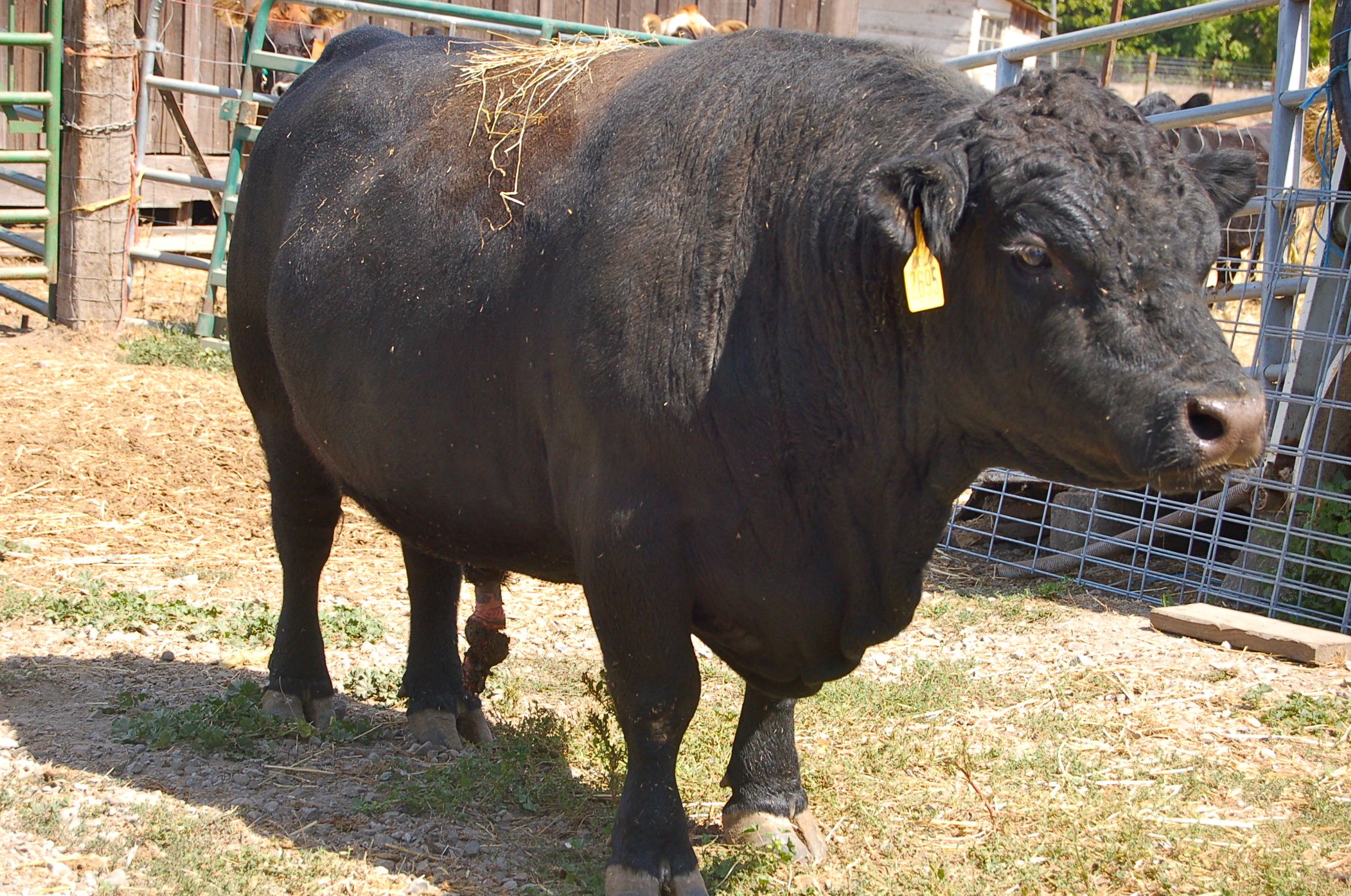
And then there are temperament issues.  Like I said, a milk cow tends to be mellow and gives up her calf easily but a beef cow is very protective of her calf (and her udder). She may not want to be separated from her calf or follow you dociley into a metal box and just stand there.  (Remember, her world is the wide open pasture and she must protect her young from predators!)

Jersey/Lowline (aka Jer-Low)

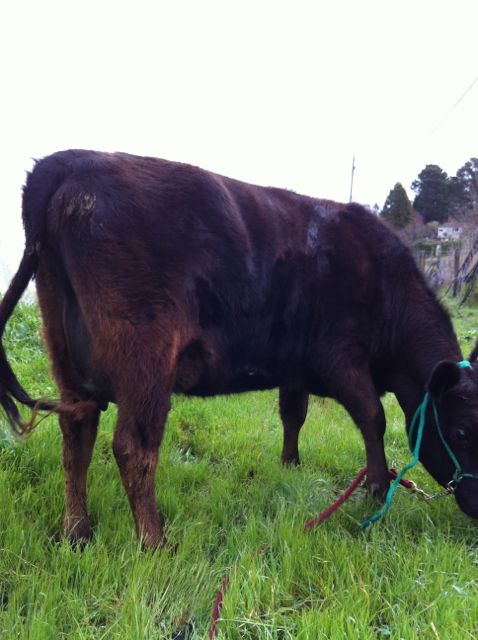
Cocoa, is our first result of crossbreeding a milk cow with a high-end mini-beef bull.  She was a bit taller than we expected, her coat is darker than her mother (but not solid black like the Angus), and she has more of the dairy build with a more pronounced udder and excellent teat size and placement.   Something you don’t really know until she has her first calf. (Bessie has teeny, tiny teats which makes hand milking very difficult!).
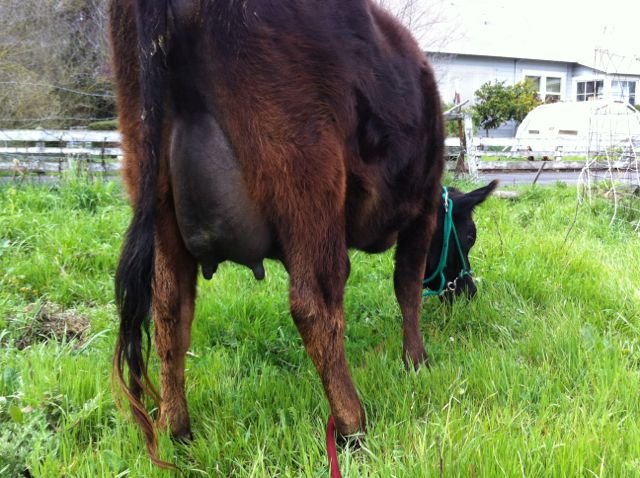
I was running over in my head the need to take her into the milking trailer and just feeding her there a few times to get used to the space, adding the milk strap that goes over her back (which will hold the milk bucket under her), and in a few days, actually turn on the pump (noisy, although it IS placed outside the stall)… but letting her build up a tolerance to all the “new” stuff.  All the while rubbing, brushing and sweet talking her.

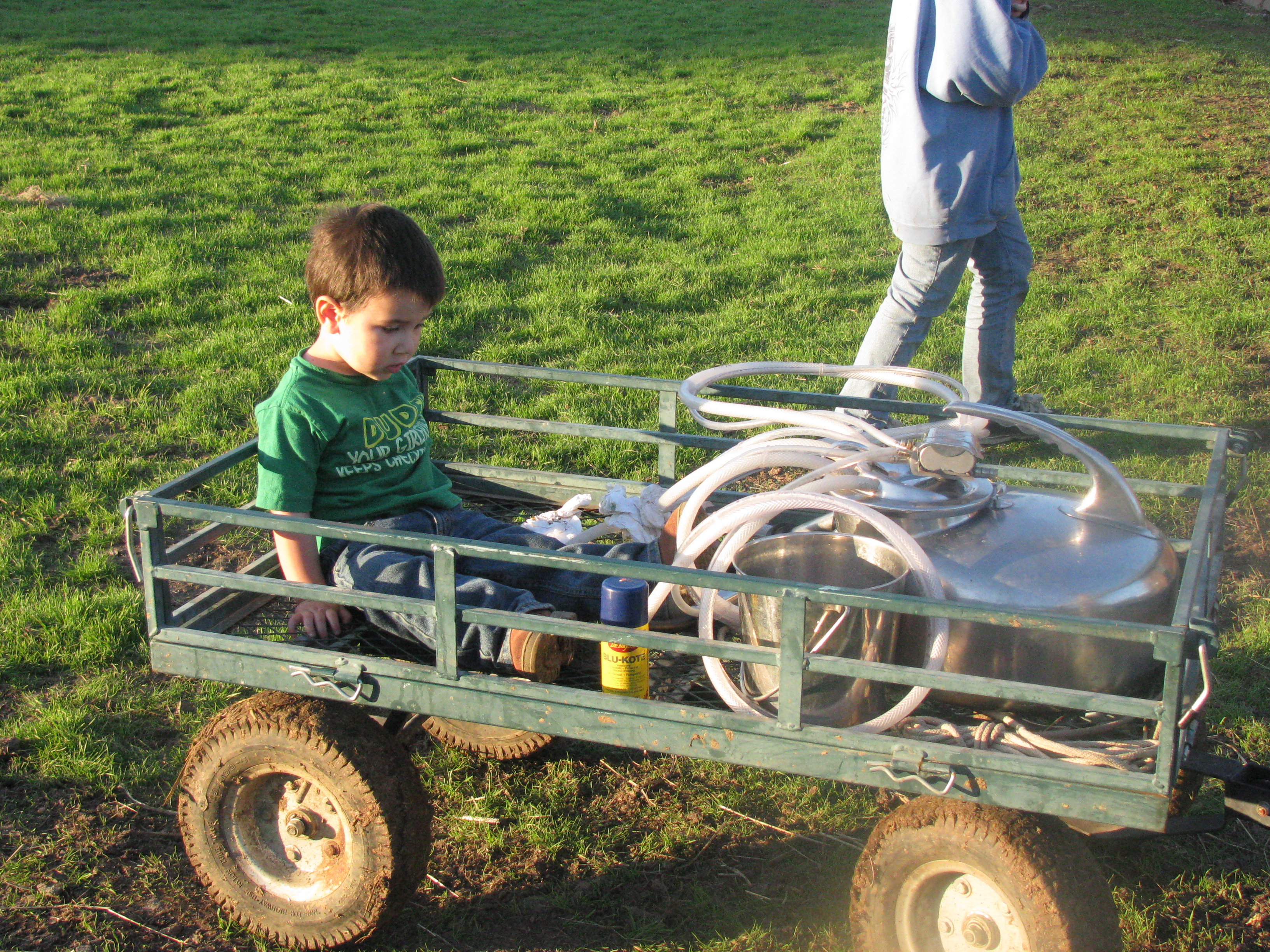
In the meantime, Job (our intern) goes out to the pasture, brings her into the stall. He just skips to the end and gets it DONE.

Now I grant you, she needed some rear pressure to get her in the first time but once she discovered the fresh hay and a bit of grain she was a convert! The next day, she headed in without missing a beat, and Job, with his long legs stretched out under her, proceeded to hand milk her. I think, after milking her, he did turn on the pump so she could near the noise from it and realize that it wasn’t going to hurt her, or take her food!  The next day… you guessed it, Job put the portable milk machine on her and that was that.
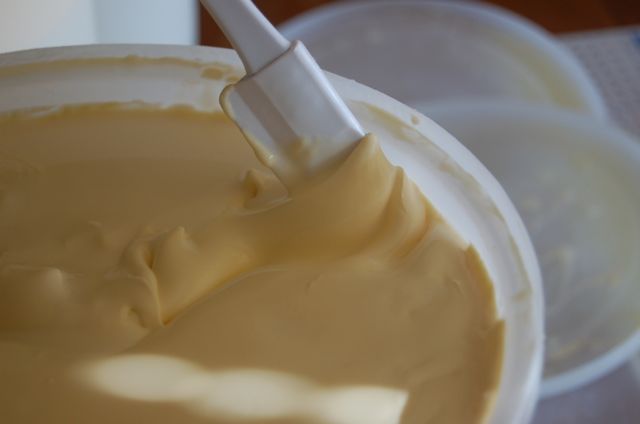
Except, bless her udder, she gave more and more milk each day. Luscious sweet raw milk, with a rich yellow tint that speaks of lots of vitamins,  from the pasture she has been on. When the milk “settles” it has a layer thick with cream that we will harvest to make butter (or ice cream or real whipping cream).

All my worry and problem-solving down the drain… Job just goes out and does it.  Did I mention that he is brand new at this game?  Awesome!

It was wonderful to find that Cocoa has kept the best traits from her dairy side… while her bull calf will be valuable to the small acreage for very usable meat… he is 3/4 Lowline Angus and will have excellent genetics for quality beef. A Two-for-One package deal: milk and beef. We call that success!
Interesting Tidbit

Discovered that you can tell how many views of the blog posting, and WHERE the views originate!  Thought you might find it insightful to see, as well.  I’m truly surprised at the broad reach postings have traveled. Almost 20 countries, including Morocco, Malta, Fiji…. who would have guessed. Over 1500 views in 10 weeks… just incredible. (list at bottom of post)

While Ruminations is focused on a small family farmstead in the USA,

building trust with the cows

and the happenings on the farm and how they relate to the broader picture, I wonder how other cultures/countries view what I have to say.

I know I have friends from other cultures who mourn the loss of their capacity to be in touch with the land & food production. They are working to return those values to “their world”, as well.

It all has to do with localization, I think. That and rebuilding local community.

Waiting for something to happen on the larger scale (government, business, etc) is just NOT going to happen. If its not about making more money, it’s long-term value seems to HAVE no value to them.

So it is up to us, and our neighbors, and our friends… to support our local resources… encourage, nurture, and give that positive feedback.  We have to take back control of quality, enriching the earth, and thinking long-term… it will matter to our children and grandchildren. We can choose to be victims, or we can choose to make a difference, however small it is.

Anyway, hope you continue to follow this journey with me, as we experience “our return” to an “integrated homestead”! Where land, soil, livestock, gardens, all play a part in an ecological cycle that is complete… Where there is no waste… everything, at some point, becomes an input for something else… just as it does in nature.  Mother Earth has spent 4.5 billions years working out this process, and we are only beginning to touch on the subtle relationships that she has developed.

Patiently we watch & listen… and hopefully, learn!

Country Views
United States FlagUnited States 522
Canada FlagCanada 19
United Kingdom FlagUnited Kingdom 14
India FlagIndia 5
Taiwan, Province of China FlagTaiwan 4
Ireland FlagIreland 4
Fiji FlagFiji 4
New Zealand FlagNew Zealand 4
Egypt FlagEgypt 3
Philippines FlagPhilippines 3
Australia FlagAustralia 3
Germany FlagGermany 2
Korea, Republic of FlagRepublic of Korea 2
Morocco FlagMorocco 2
France FlagFrance 2
Bulgaria FlagBulgaria 1
South Africa FlagSouth Africa 1
Malta FlagMalta 1
Turkey FlagTurkey
Ear Piercing Squeals

It occurs to me that Mother Nature has selected for the loudest, most piercing squeal possible, in piglets.  Those with the loudest voice got the most results.

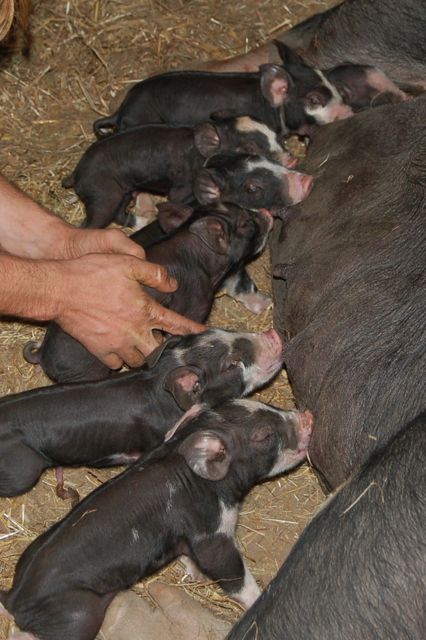
All Momma Sow's piglets lined up to nurse

Mellow, easy-going guys fell by the wayside (or in real world pig terms “got squished or eaten”). If you didn’t speak up for yourself… you might pay a pretty deadly price (literally, of course)!

Those who squealed the loudest and the quickest, got a response, whether it be a 300 lb mom trying to sit on you, or if you got separated from the “herd” and needed finding…because alone, you were food for the predators!

SHARING…

We invite our visitors (or maybe twist their arm to come see our newest babies!), but anyway… take them out to the farrowing pen. Take them to see all the little ones racing around, burrowing into the hay piles, and trying to chew on each other ears or tails to see if they give milk, or crawling on top of other sleeping piglets to join in a group nap-time! At least until mom gives out the special grunt that says, “come and get it, kiddos… lunch is ready!”

Until that happens the piglets enjoy exploring their world. Job, our farm intern, scoops up two little guys and hands one-off to visitors so they can feel how soft the skin is, and generally, just get a chance to cuddle one of the babies. Who ever gets to actually touch a piglet!

Only, once the piglet realizes it is off alone, all by itself, with unknown creatures stealing it away from  his siblings… he lets out an ear-piercing squeal, and doesn’t stop. If you didn’t know better you would think he was being tortured instead of cuddled! And let me tell you, it’s a non-stop squeal that just gets more tortured sounding each moment it continues.

It’s all the same… you can turn it off… at least, on YouTube!!!

Mom perks up immediately to see just what is going on.  Job is standing in the pen, still holding the other piglet (who hasn’t yet figured out he’s all by himself & thus has NOT started squealing… but will shortly, I assure you).

OH NO, Momma begins her investigation and notices that Job is holding one of her babies.  She makes her way up behind him, and very carefully (I tell you, she IS a good mom, but a GREAT family farm pig) puts her mouth around his calf and gently mouths his leg.

HISTORICALLY…

Now this is impressive… because my husband freaks out.  In his teenage years, he was responsible for 400 pigs and learned to jump a 5 ft high fence, from a standing start, in a micro second. His experience was that a momma pig would take a hunk out of you without ANY warning… if they were even a bit concerned about a piglet.

A warning nip was just not in their repertoire! But a trip to the hospital would be in your immediate future, if you ever lost sight of where and what that mom was doing. Our pigs are bred for a better temperament, but it’s always better to take NO chances.

Job reached back quietly and put pressure on the mom’s shoulder, pushing her away, as he put the piglet back on the ground, all the while talking quietly to her.

Our visitor quickly handed the noisy baby back to Job who got him back to mom, as well. Job continued to keep pressure on the mom, and then began to scratch her.

What an intuitive touch… she responded to his returning her babies and then the treat of a good scratch.  Rather than lose his cool, he worked with the mom and reassured her. Elements of an excellent farmer… one who tunes into the needs of the livestock he is tending.

A FARM EXPERIENCE…

Going out on the farm, to milk!

I have to say that one of the greatest pleasures on our farm is being able to offer hands-on learning experiences at various levels.  Whether it be kids coming out and seeing a momma hen, roaming freely, gather her chicks around her and teach them to scratch, or young adults who want to learn how to milk a cow, make butter, or experience what it is like to care for animals on a day in,day out basis, it each has its own value.

In our lives today, we really live very disconnected from real things. We watch life. We watch movies, reality TV, play video games, interact on-line. We are, for the most part, passive participates in life watching other’s live a fantasy.

We don’t get too hot, too dirty, too tired, too anything.  We are always somehow “connected” (or is that “wired”) into the world and yet, not.

We bike, hike, sail, swim, skate, ski, play baseball, tennis,etc., but it’s usually very recreational and for our own pleasure. Somehow in doing something that is actually productive, there is another quality that comes into play. A sense of connectedness with the world that reaches into the soul. How can you explain color to the blind man?

Ever just stopped to listen… to see… to feel…? We’re always so busy on the way to something that we never stop and actually experience life.  Take that moment out to “just be”. To stop being in control of everything around us.

THE QUIET TIME…

One of the things I enjoyed about milking was the forced quiet time.  I could check out of the rest of the world… and just spend the moment with Bessie as she chews her hay, the milk machine clicks away, and the sounds of the barnyard drift into the milking stall. Bessie’s warmth and smell comfort me in a way I can not really express.

Probably because our culture has lost the words that express those experiences…. sadly.

Quiet time in the day, to milk Bessie

This little piggy….

Whoops: Change of Plans

We were headed out the door to head to town when our intern alerted us.

He walked by the pregnant gilt’s farrowing area… and saw three baby piglets!

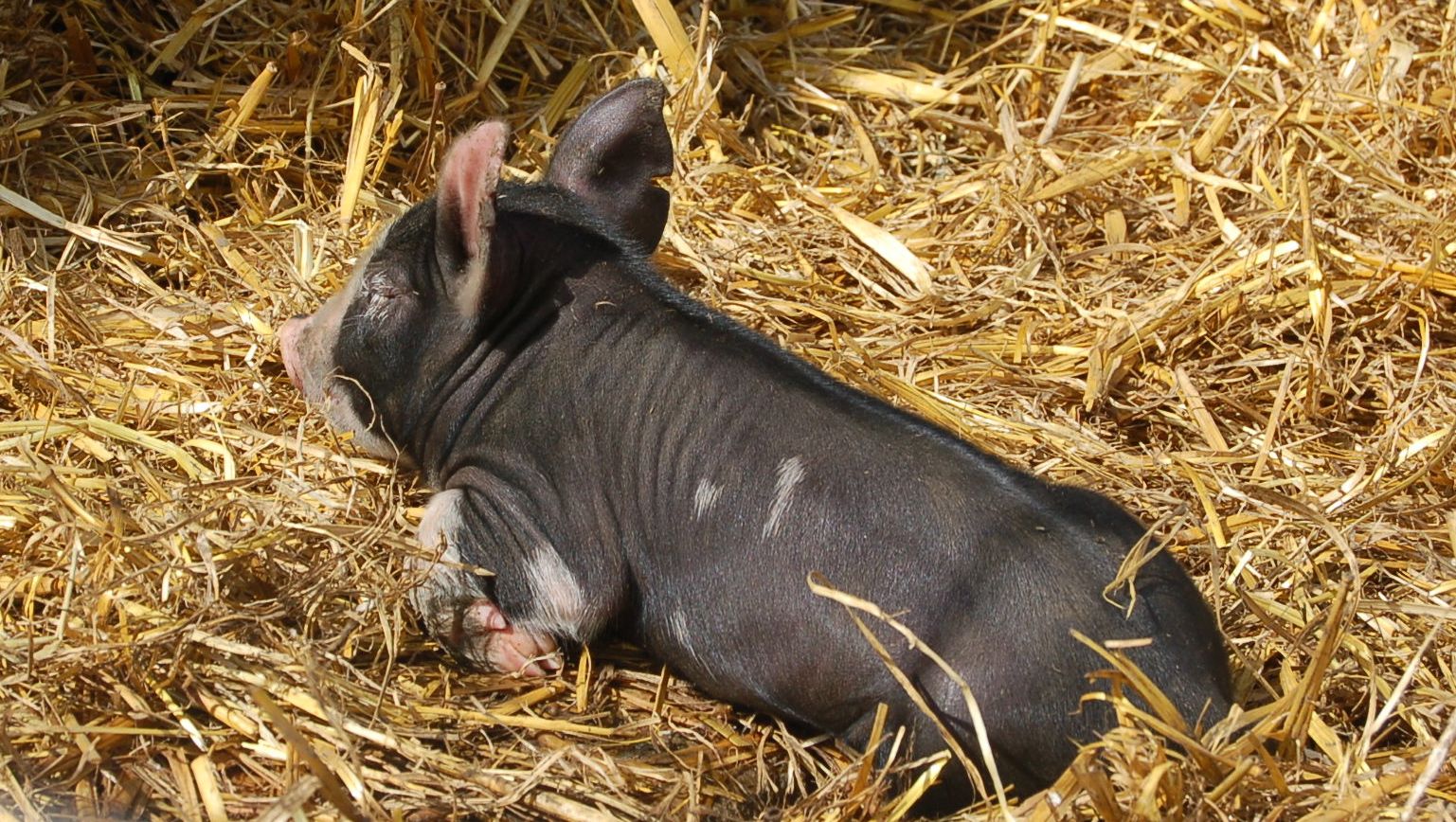
Newborn piglets, dozing in the sunshine

One was still wet and working on figuring out which way was up. He was that new.

I grabbed a towel, my cell phone (to call and delay a meeting), and checked to make sure I was wearing something that could get grubby… very grubby. No telling what I would need to do… stand by and just watch a normal labor process, dash in to grab a piglet who was in trouble, or even help deliver babies if the gilt’s labor stalled out.

I say “he was that new” just because I don’t want to check the sex and upset the newborn, and trigger ANY squealing. Turning a newborn upside down and poking around, for some reason seems to initiate an ear-piercing squeal that WILL not stop until he is put back on the ground.  Our new momma has VERY strong instincts and will immediately jump up to defend her newborn.

Unique

Pigs are very interesting creatures as they deliver their young in a totally different way.  Cows, horses, cats, dogs, etc. all deliver and to some extent help their young… usually by licking them to stimulate, to clean off, and to help dry them. But piglets do it all on their own!

Mom lays down on her side and labors.  She gets up occasionally and may go check on the babies delivered (just sniffs them) but then she goes back and lays down.

The critical part is that if there is a newborn where she lays down, he must have an escape route! 300lb momma laying down on a 3 lb newborn can have some very distressing results.

Jim designed and built (with intern assistance!) angled areas in the corners of the farrowing stall.  Enough for a person to stand behind & in.  The angle area cross pieces are NOT all the way down to the floor.

Job, making sure the newborn piglets are safe!

If the momma sow lies down next to the angled area (which of course she does), there is a space that allows the piglet to move away from mom, and she is blocked from that; the piglet can shift into the protected angle.  We have flakes of straw in those areas so the piglets can burrow in and get warm.

Momma pig lays down and breaths/ pants with her labor and then will give a push. Out flies a piglet still encased in its amniotic sac & still attached with the umbilical cord.  As the baby “hits” the ground the sac is pulled away from its snout.  Sometimes the cord “snaps” (i.e. breaks at the delivery & sometimes not).

At first the newborn is totally still. My heart always stops until I see a little wiggle or flip of an ear. I have to consciously “STOP” myself from helping out!

Finally, real movement. The newborn is “shaking off” the shocking introduction to the world! As he begins to move around, the sac encasing him, breaks away.  As he wiggles around, and then finally finds his feet (usually less than 3-4 minutes), he is pulling on the umbilical cord and it  breaks away so that he is free to move away from mom.

On average piglets delivery every 20-30 minutes. We’ve even had them deliver an hour apart.    Our new sow proceeded to deliver piglets at the rate of one every 10 minutes! That includes taking a break occasionally, getting up, nosing around to sniff & nuzzle her newborns.  After a brief check, she goes back to lay down…  carefully, so that any piglets in the way can move, and if they are trapped under her, squeal. A good mom whe will immediately jump up to prevent any squishing of newborns!

Cautious, is the name of the game!

Job, our intern, had never dealt much with livestock (thus part of the reason he is at OUR farm).  Jim had gone over a few techniques to use when working with the laboring mom, and he went right to work.  If mom gets a little bit shook or worried, she can be calmed by rubbing her belly.  Initially he stayed in the protected angled area, where he was in place to rescue a piglet if he needed to. He was just a hands-breath away, and had a clear view of what was happening.

It’s an unknown situation with a first time mom. Some sows can become confused, very aggressive and protective.  We had a sow who started to attack her first baby (it was her first litter) because it was squealing.  She hadn’t quite made the connection that it was her baby squealing but thought the baby was “attacking” her newborn.  We quickly had to scoop that newborn out of momma’s reach & calm her down by rubbing her belly.

As this was a new sow, and this was her first litter… we had no idea how she would act.  I must say, we were really impressed. She will be a keeper. First off, she had 12 healthy piglets (no runts & no super big piglets)… all pretty much 3-4 lbs each.  She was mellow during her labor and very careful of her newborns, even in the middle of labor.

Some TLC for the babies…Nursing

The first group of piglets are now quite hungry and search for a teat to nurse on. Momma sow has a minimum of 14 teats, seven on each side, but getting on for the first nursing can be a challenge. Job works out a method.

Piglets first nursing

When all 12 try to nurse and get to the upper seven teats, nobody gets to eat! Oh, I’m sure eventually they would but to short cut the drama, and make sure each piglet has gotten a good first nursing of the colostrum, we  assist. Remember?  that first milk which has lots of goodies in it for the baby – immunities passed from mom to babe. If a newborn does not get a good nursing within hours of birth, he will tend to be sickly or just not grow well.

So Job divides the group up into two parts, each made up of 6 piglets.  He corrals up one group away from mom, and then makes sure each piglet finds and attached to a teat.  Over a few hours he has made sure all the babies have had several good nursings. What an outstanding start!  And whenever mom would get a little anxious, he would just rub her belly and she would flop back, and snooze.  When Job brought her sweet cob, grain, and curdled jersey milk (her favorite), in a low bucket, she didn’t even bother to get up. Just picked her head up, pushed on the buckets edge until it tilted toward her, and munched away happily on her treat.

In the past, when we’ve had a sows labor stall out, we’ve put piglets to the teats to nurse, to stimulate more contractions. The nursing process releases hormones that trigger the let-down of  milk, and uterine contractions.  I think it’s Nature’s way of making sure the labor process is completed and the placental tissue is passed.

Nighttime…

Enough for now; we’ll leave the babes & mom alone and “pray” they get through the night OK.  I always worry about the little ones getting squished but this mom is very careful. She moves slowly, watches, and nuzzles the straw before she lays down.  If she hears someone start squalling she will immediately jump up, and then carefully try again.

Mom and babies sleep separate! All the babies bundle together, overlapping each other, usually burrowing into the straw… and keep each other warm.  When mom carefully lays down, she will then call to her babies and they all come running, to nurse. But when done, the babies gather together and sleep in their little angled protected area, or huddled together under a flake of straw.

Reducing Losses

If you don’t have a “good mom” you could have a 25-100% loss of piglets! That’s why in the swine industry, in their confinement system, the moms are put in farrowing crates, that barely allow her any movement.

We have lost several piglets in the past, with different sows, because the moms were not careful enough during and immediately after labor. We switched breeding lines to see if we could improve our delivery numbers and survival rates.  In the past we would have 8 piglets, with 6 surviving delivery. Generally never lost a piglet after the first day.

Selecting for Survival

But our approach is different from the industrial model. Instead of using every sow, even if she is not a good mother, we selectively choose who will breed. That way our stock will get better… need less intervention, be healthier, and more productive. Strikes me that the industry method is decreasing the quality of the breeding livestock, over time.

We aim toward a sustainable model, where livestock don’t actually need humans to survive!

Spring Babies, At School, At Home

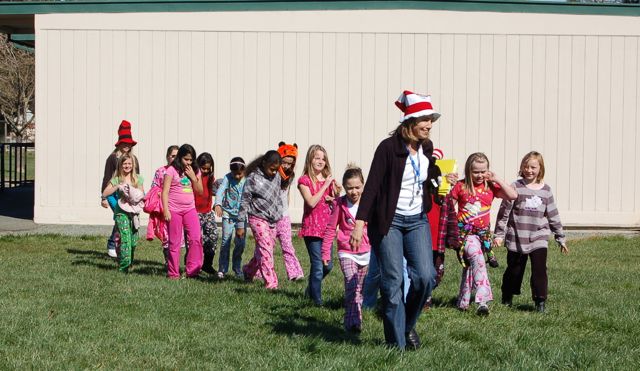
A hands-on visit at school!

Spring Babies to School

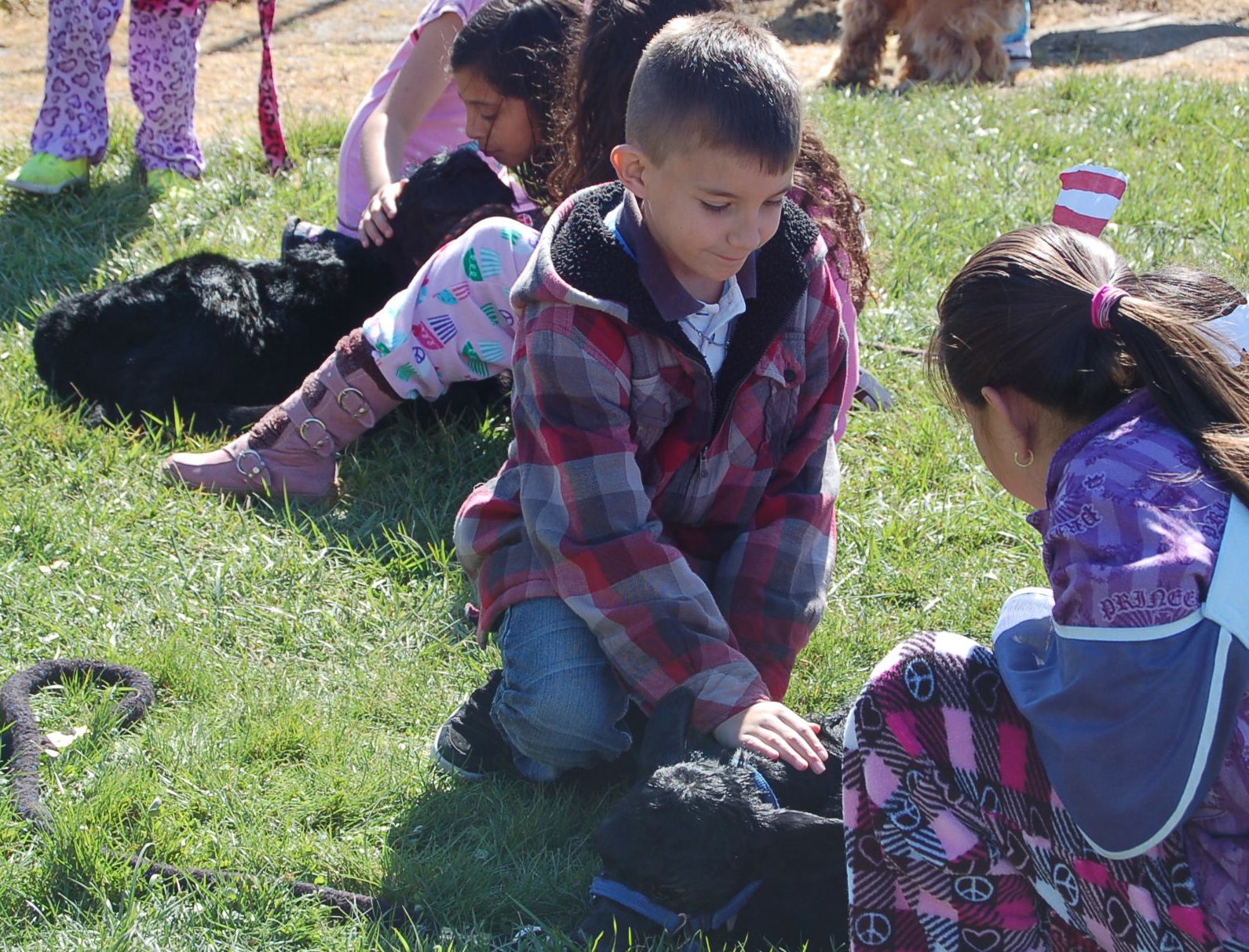
Taking our farm animals to the local elementary school is pretty high on my list of things we want to do.  Especially the young ones… they appeal so much to the kids. We took three calves (2 beef & 1 milk breed), as well a 2 mini-horses to the school.

On the Trailer, to the school

The calves were from 2 days to 6 weeks old. With a neighbor’s help, we loaded them up and a short trip later, they were out on grass being introduced to the students.

It was a chance for the kids to talk about, see, touch, and learn about real livestock. They get to see them pee and poop! call to their mothers, to their friends.  Get tired & lay down to take a nap!

They are able to check out the mini-horses in great detail, as mini’s are busy eating fresh “playground”… and of course, leaving some fertilizer behind as a “thank you”!

I like taking the smaller creatures because I think they are more “kid-friendly” size… as well as having a naturally built-in “baby” attraction that we all seem to have in our make up. We are drawn to babies and want to “nurture” them.

Great Discussions!

We talked about how soon after a calf is born, can it walk.  Guesses from the 3 & 4th graders ranged from hours to days to weeks.

A chance to actually touch a calf

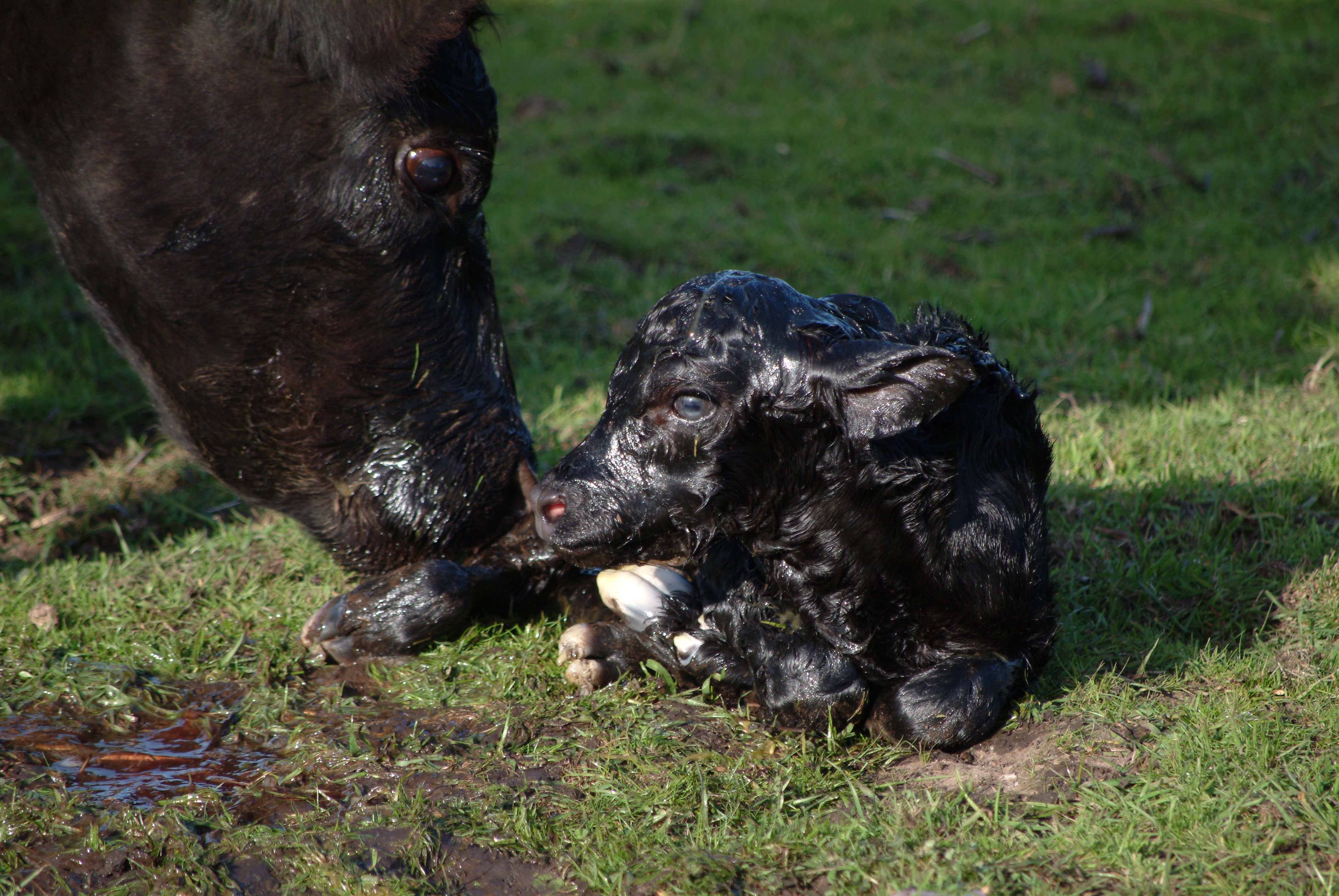
I told them that the calf is born with hooves that are very soft… too soft to walk on. They look white at birth.

Newborn Lowline Calf, still hasn't stood-up yet!

The hooves are soft so that they don’t hurt the mother when the are being born. It’s like having your hands in water for a while; your fingernails get really soft. But as soon as they are exposed to the air, they begin to harden up.

In nature, the calf need to be able to stand, within 30 mins usually, and navigate to the udder to nurse, within a few hours at the most.

There is a “key” window for the calf nursing.  The best is within 2 hours, but 4 hours at most.  That is when the calf’s gut is open to absorbing the immunities that the mom passes on to the calf.  If he does NOT get that special milk, he will tend to be very sickly and not grow well.  It’s important for him to nurse as soon as he can. After 4 hours the gut changes and begins to lose the ability to absorb the larger molecules. By 12 hours that door is completely shut.

We always try to have some of that special early milk (colostrum) saved up in our freezer if we have a baby that has a problem with nursing or a mom that can’t produce the milk.  It’s good for calves, colts, kids (goats), lambs, etc!

This is a “real world” experience.

group discussion, and then hands ON!

It’s amazing what a great time we had talking about the livestock, with the kids. I was impressed at their questions and how much of an in-depth explanation they where able to take in.

They were very excited about learning about all the things that actually come from the milk the jersey cows produce.  They were able to name off quite a few items besides milk; cheese, butter, yogurt, whipped cream, ice cream, but NOT actually chocolate milk! Well, not the chocolate part, anyway. I think it made it very real to them.

As their teacher said, “Most kids see the world through books, pictures, TV, movies, video games, cartoons, computers…. but never REAL, in life!”  I was told that last year, when we brought animals, the kids talked about it for weeks.

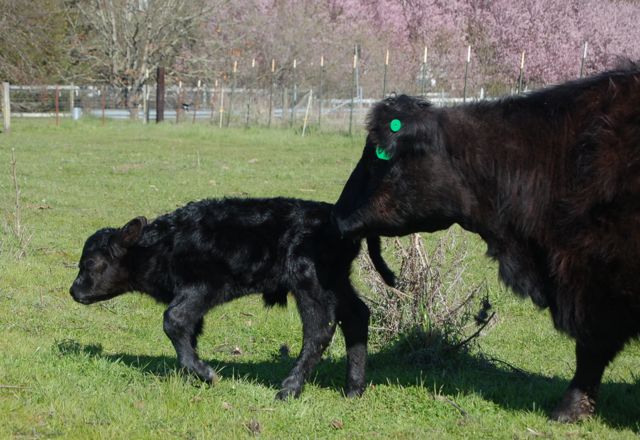
first steps of newborn calf

Spring Babies on the Farm

Today we had newborn calf just suddenly appear… I love our compact pastured beef livestock.

They do their JOBS so well.  They convert the green grass and hay for their food energy.  They get pregnant, at the drop of a hat, and then proceed to calve with hardly a murmur. And smart enough to do it on clear, sunny days, for the most part.

Interestingly, the cows/heifers synch their cycles!  What that means is that they will all deliver about the same time.  We had three newborns this week!  Unlike commercial farms we don’t use medications to make the cows ovulate at the same time… but in nature, at least with the Lowline Angus breed, they do it themselves.

Safety in Numbers

Now WHY?  This is a comparatively old breed, Aberdeen Angus, so I think the older drives are much intact. In the wild or out on extensive pastures, it is actually safer to calve at the same time… and it’s usually early spring.  Why would that be safer?

Coming out of winter, the predators are looking for food, and young livestock are a perfect meal.  If there is only one calf… the chances of it being “prey” go up significantly.  If there are a dozen calves, then there is safety in numbers and the odds are YOU will not be dinner.  And by the time predator comes back, the calves are older and able to manage escape! Mom’s who tended to cycle together had more survivor calves. Outliers (those who delivered at odd times) did not have offspring with as high a survival rate.

Bigger is Better, NOT

I feel so sad when I hear stories from other farmers/ranchers who talk about their difficulties.  Having to get up in the middle of a (of course) cold, windy night (or freezing sleet night, or howling winds), … to help a birthing cow. In their stories it NEVER happens on warm, sunny days, mid afternoon!

Calf puller, for those that are too large for the mother

They also have these horrific looking devices to attach to a calf and pull it out, found at your local farm supply store. For those “Too Big Too Deliver Syndrome” calves!  Our calves weight in at around 40-55 lbs.  Standard or large breed calves weight in at 75-120 lbs AT BIRTH.

We have never lost a calf or mother, at birth because it was too big or badly positioned, which is sadly not true of the typical large beef breed ranches. But then, we only have at any time, 5 – 15 cows…

But many ranchers are beginning to see the advantages of the smaller calves, especially for their first time moms (AKA a heifer – never had a calf). They use Lowline Angus Bulls to decrease the size of those calves to make for very easy births! They lose fewer calves and their night’s sleep are NOT interrupted. Makes for a much happier farmer/rancher.

A breakfast surprise... new calf

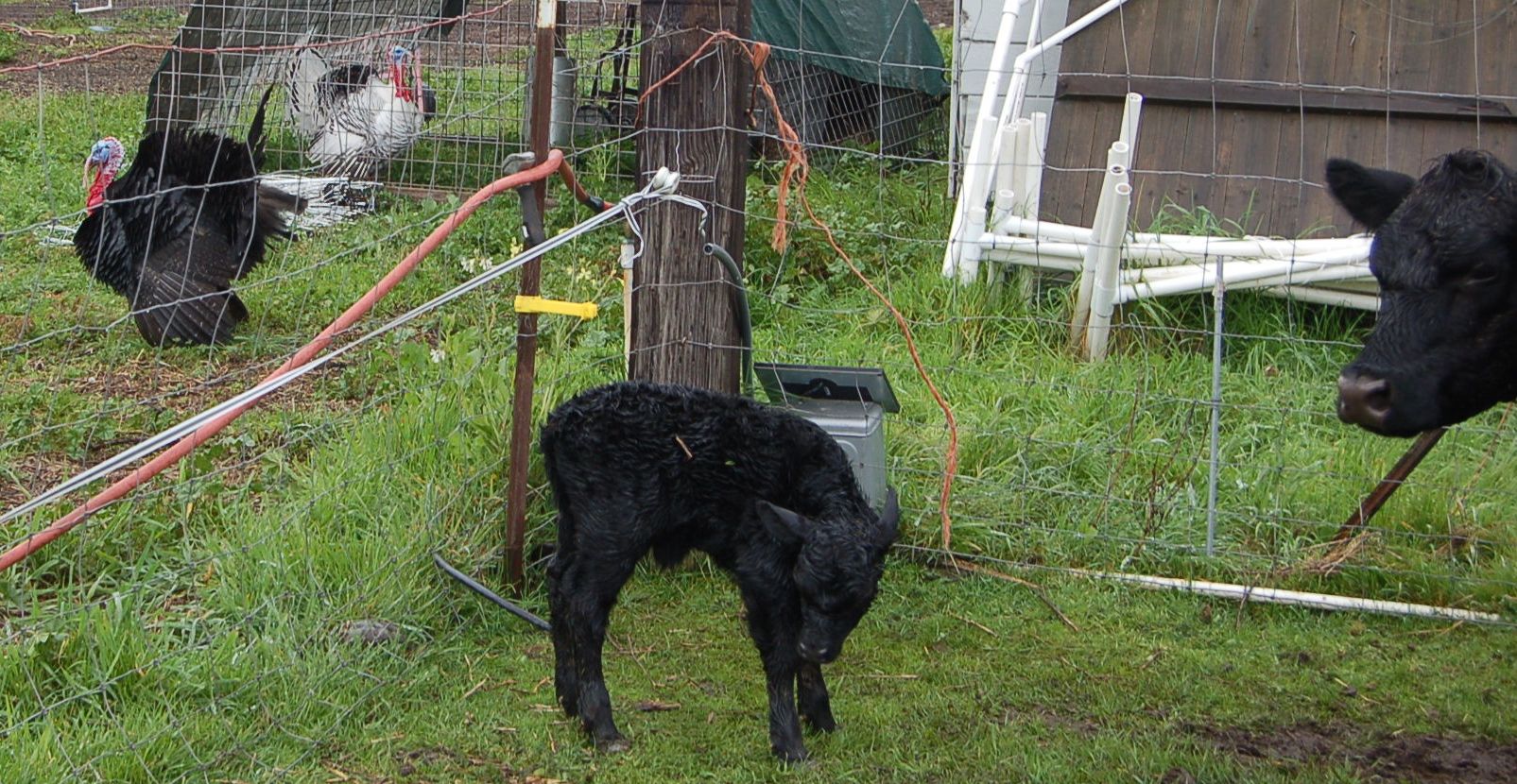
But for us… Our experience, as our new intern said, “Oh, I was feeding this morning and an extra calf showed up!” I think Big Momma has delivered.

We were able to finish our morning coffee; then go out to see if we had a boy or a girl!

What a life… just love it.

Seductive Spring Garden Trap

I was seduced. Yes, definitely… against my will (i.e. my better judgment). The warm sunny days worked their magic on me.  I KNOW better than to plant a garden too early in the season.  It’s really an exercise in futility to try and outwit the “weather gods”!

Transplant starts

Spring Starts for the Garden

Yep, I went down to our local nursery (key word there is “local” nursery)… and perused among their garden starts.  Trays of tiny plants just waiting to be snapped up and placed into a warm nurturing environment so they could explode into growth, providing me with feeling of satisfaction of having something growing.

When I asked at the counter for some assistance in finding some “Sweet 100” tomato starts, they chuckled and said, “Don’t you think you are just a couple months to early!”  It’s too cold  at night and they will just shrivel up and die with the first frost.

Season extension

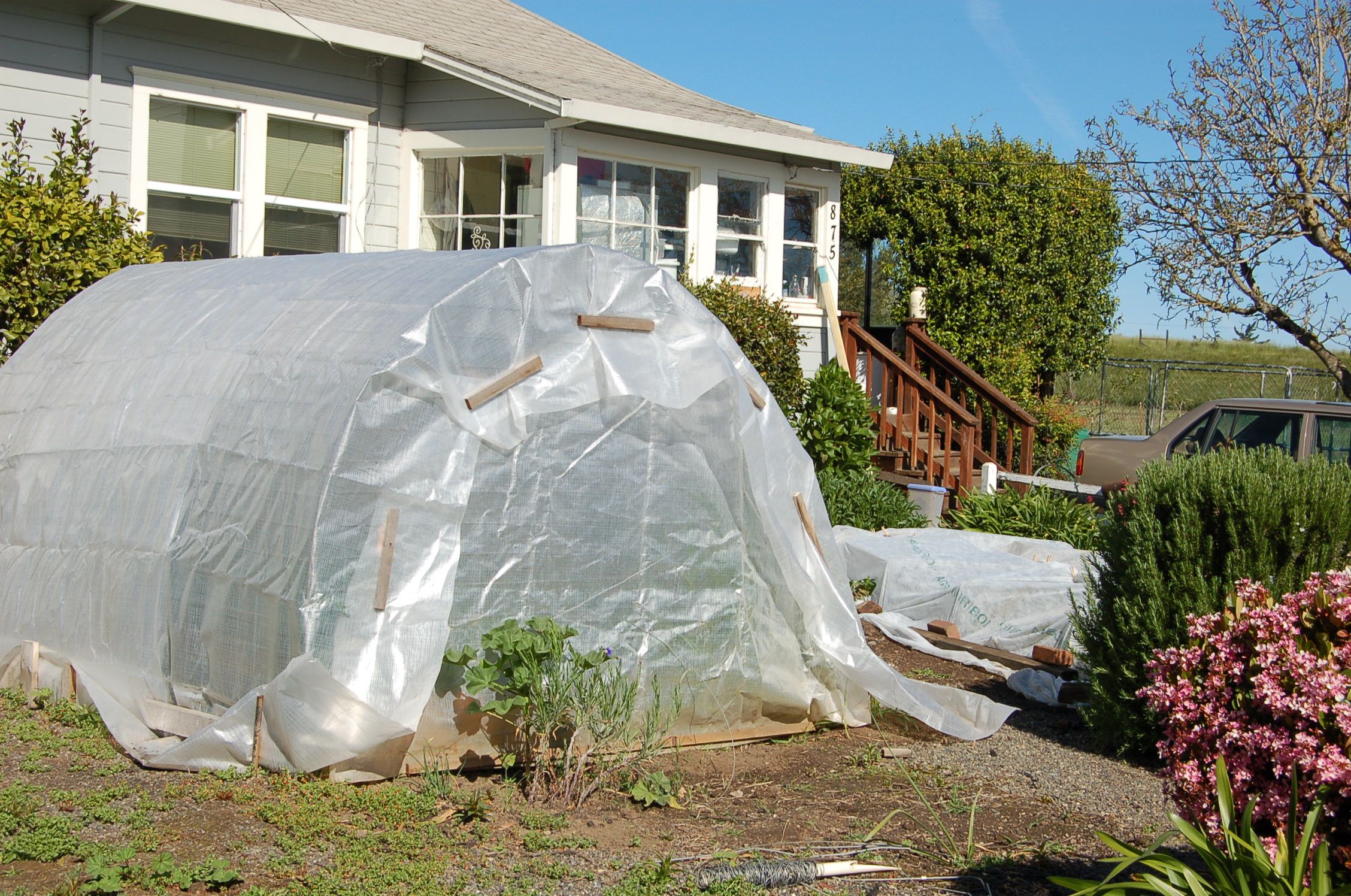
Simple Greenhouse- Hog Panel

But boy did that tune change when I said the magic words…. greenhouse. Lovely, lovely, warm, protected, sheltered greenhouse.

Now mind you… nothing fancy.

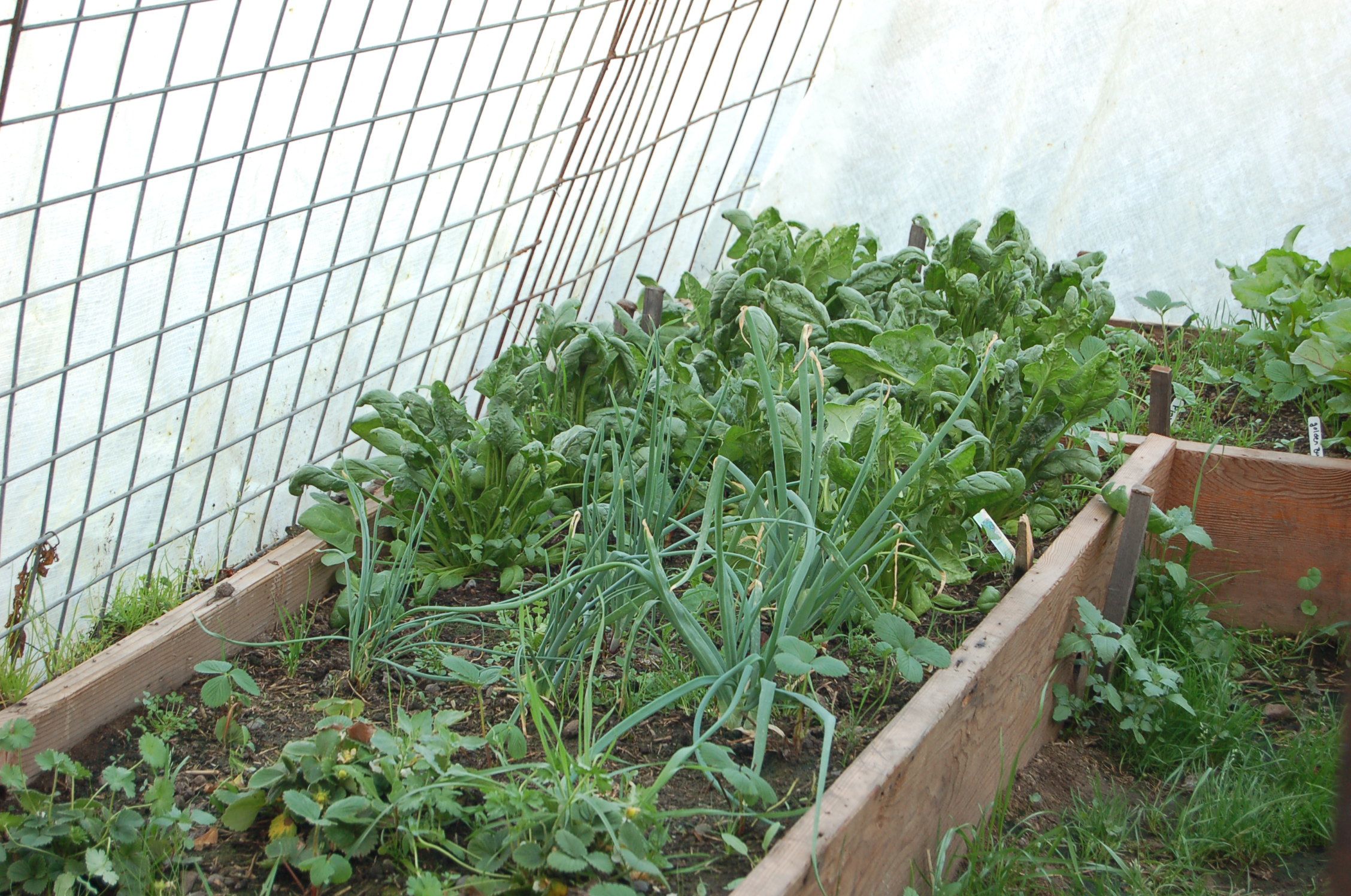
Just an ol’ hog panel (it’s 16 ft length arched over to form a tunnel) with some heavy-duty plastic over it and some coverings placed on each end.

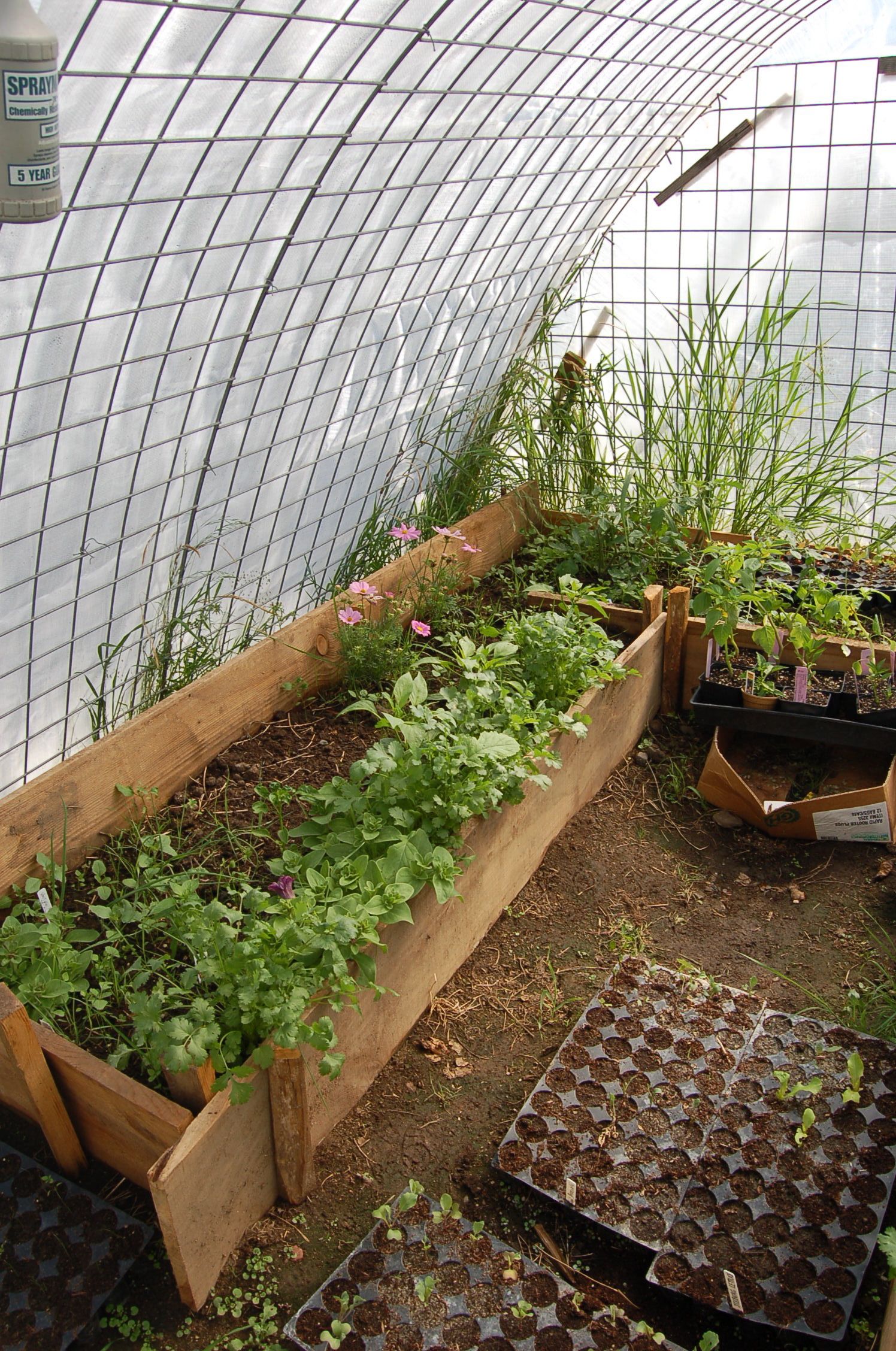
Not fancy but definitely functional. We did build some raised beds (lined with chicken wire to protect those delicious roots from munching gophers) to plant into.  In a raised bed the soil warms a bit earlier which gives another advantage to planting in the greenhouse.

Inside a hog panel greenhouse

Simple Season Extension - inside

So, while I did “buy” transplants way too early, by the time I got home, my better judgement did kick in and instead of planting into the ground  I placed my starts in their temporary waiting place. And sure enough, that night for the first time in weeks, the nighttime temperatures dropped into the 20’s!

I’ll be watching the weather report closely.

But I did exercise some common sense, and MOST of the starts that I purchased, are for cool season. Peas, snow peas, spinach, kale… all things that can handle a light frost.

The warm season starts will need a longer stay in the greenhouse… but  if I do move them out a bit early there are some short-term solutions!

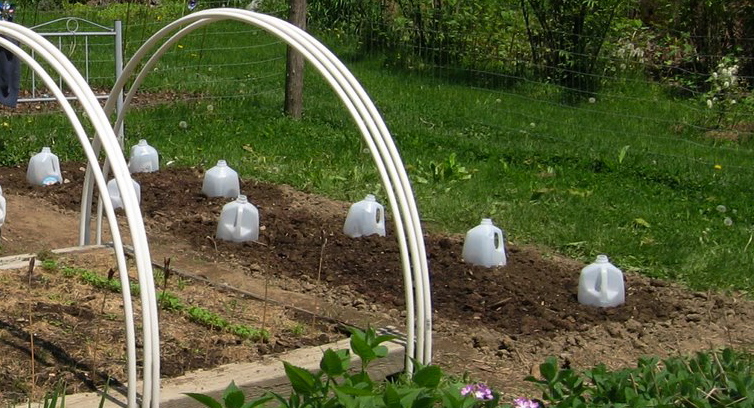
A gallon milk jug, with the bottom cut out, makes an excellent in place micro greenhouse.   They provide some protection from frost as well as a slightly warmer environment that is plant friendly. Just be careful to NOT cook the plant on days that get really warm.  Nice thing about the gallon milk jug… you can just take the cap off and presto! you are venting the extra heat. Talk about cheap and easy… instant success.

mini greenhouse - Milk Jugs

Gallon Milk Jugs for mini greenhouses

Pastures… never enough!

We are on the look-out for pasture…. always. We drive by fields that have lush growth and nothing happening on the land… and salivate.

Pasture for livestock

And I’m a city girl turned “farmer’s wife” in my older years… We’ve just been doing this for about 5 years, but my world view has changed dramatically.

Someone said one time to Jim & I, that once you start working with livestock, you will never look at land / grasses/ weeds the same way again.

By God, they hit the nail on the head with that statement. We don’t see weeds: we see succession growth, nutrients, and value the diversity of plants and what it brings to the soil and animals!

Those black dots you see in the picture, to the right of the brush pile… are our rather short Lowline Angus! They are taking advantage of some really rich diverse pasture. We use simple electric net to fence to manage where they graze.

We’re always looking for land that we can trade for grass/forage management… with the use of our mini Lowline Angus. Our cows add back fertilizer & bacteria that enrich the soil, leaving it healthier.

Sequenced growth

sequenced growth pattern

Did you know that there is a certain sequence to growth on land… if a field is burned there is a whole sequence of plants that grow. From those that can deal with the dead top (burned), and send down deep roots to pull up nutrients hidden in the depths of the soil.

Those plants bring up the “goodies” and then other plants take hold, using those nutrients. The soil is enriched and the new growth will eventually shade/kill out the original plants.  There is a progression of various grasses, shrubs, plants, and then eventually trees.

If you are VERY knowledgeable about the land, you can tell what nutrients are missing by what kind of plants/weeds are growing!

It’s actually all about the soil and its microbial base

An underground world of activity!

It’s the microbes in the soil that do ALL the real work… breaking down, releasing nutrients, and aerating the soil.

Plants can’t get to the nutrients locked up in the SOM (soil organic matter) until the microorganisms break it down into simple compounds so that it can be absorbed by the root hairs.

Turns out that if you transplant certain trees/shrubs, etc., and bring some of the soil where they were grown, you get a higher/quicker success rate.  It’s because the plant has a symbiotic relationship with the microbes in the soil where it has grown.  It decreases the stress on the plant to bring some of it’s “micro-buddies” along to help it reestablish itself in a new area.

Questions for Interns…

We ask our students two questions in particular:

1) WHAT is a weed? and 2) What value do weeds bring to our garden?

The usual response is… ugh, anything that is ugly, doesn’t produce something we can use, etc.

For me, a weed is simply something that is growing where you don’t want it, at that time.  My weed may be your delicacy! Did you know nettles are highly prized for great food value, and cattails have a myriad of food and health properties? Not to mention providing a habitat for beneficial insects that will actually protect your plants.  And sometimes the weeds attract the “pests” to them, taking them away from the plants we want to produce (aphids for example).

2) What value do they bring?

Depending on the timing… they preserve the top soil, they prevent erosion, bring up nutrients into the soil, help dry out the soil after the rains, or conserve moisture by shading the bare soil, when they die, their roots die and aerate the soil as well as release nutrients back.

A garden totally lacking in “extra plants” can be very sterile.  When I go out and pull weeds I remind myself of all the value they have brought.That way I don’t resent the “extra” work I have to do.  Instead of thinking I’m a poor gardener or lacking in focus by keeping my garden pristine… I have come to have a certain appreciation for weeds. It’s just part of the process.

And WHEN is it time for them to go? When they compete too strongly with the plants I’m growing for food.  When they are  shading out others, taking too much moisture, or choking them to death (good ol’ bindweed… wraps around the stem and climbs up reaching for the sun… but can choke the plant to death!!!).

At that point a weed must go; and often replaced with a good mulch which works wonders, and as it degrades, IT returns good stuff to the soil, as well.

Sunny California…

Darn those lovely little yellow blossoms

70-80 degrees F…in Febuary, no less! It’s the end of the month; we’ve had very little of our “winter rains” and lots of sunshine.

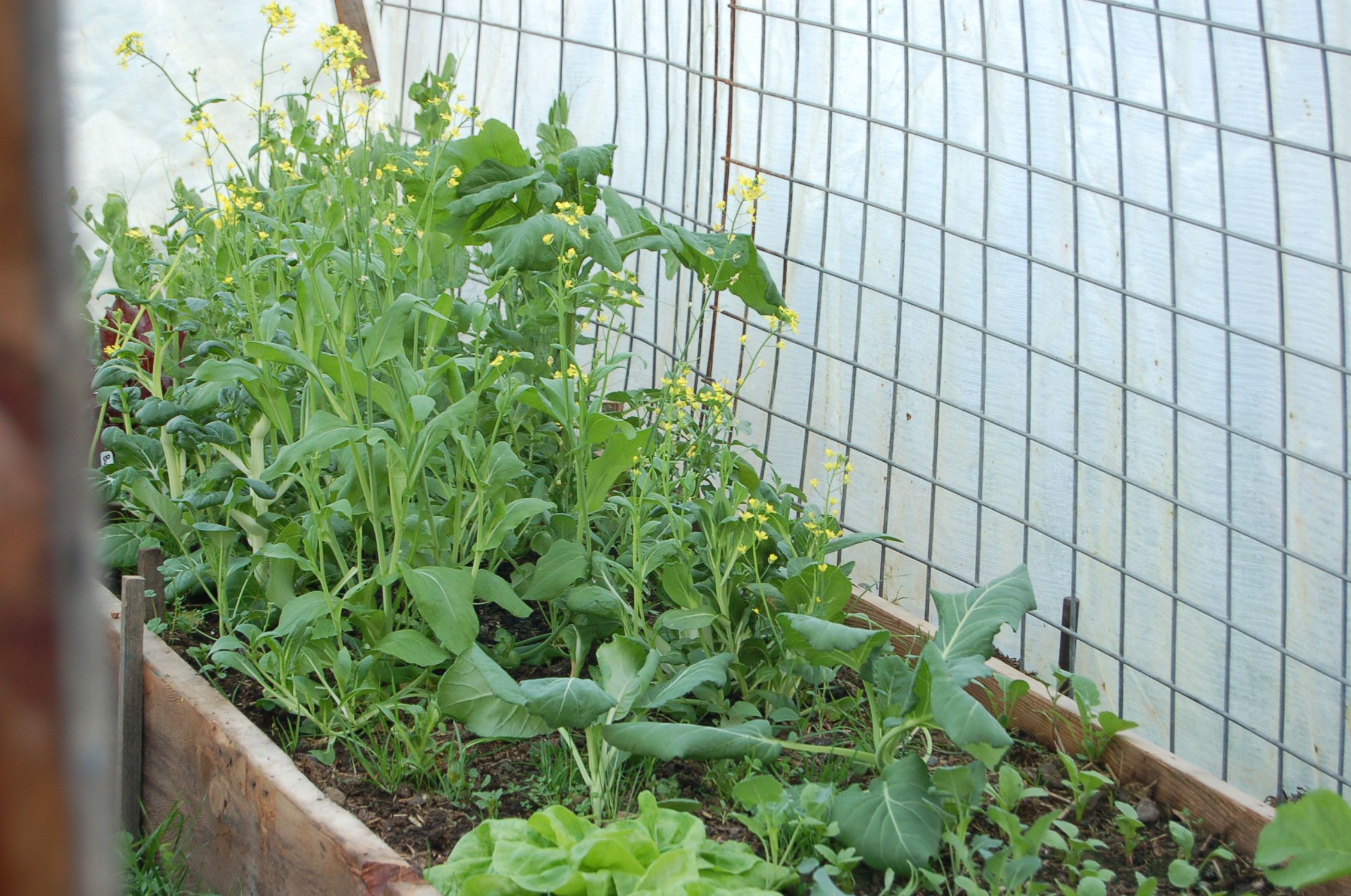
My little season extension greenhouse, that was meant to provide us with winter crops and an early start for cool season crops… has been a bit too warm.

Darn it, my cool weather broccoli is flowering instead of producing heads for my dinner table!

tolerant of the warm winter weather!

Lucky for me, the spinach, green onions, and strawberry plants are more forgiving of all this warm weather. They are humming along just fine.

But our simple little greenhouse, we actually have to open the door to cool it down… and block the entrance so my chickens don’t have themselves a feast in my “special greens”!

They just LOVE to sneak into the greenhouse.


How’s YOUR grocery bill these days?

“It must be wonderful to not have a huge grocery store bill!” I’m told many a time, by people who know we have a full-cycle farm (i.e. milk, meat, chickens, gardens, etc). I laugh and tell them that at this point, I don’t pay the grocery store, I pay the feed store!  WE won’t REALLY have it together until we can feed our livestock.

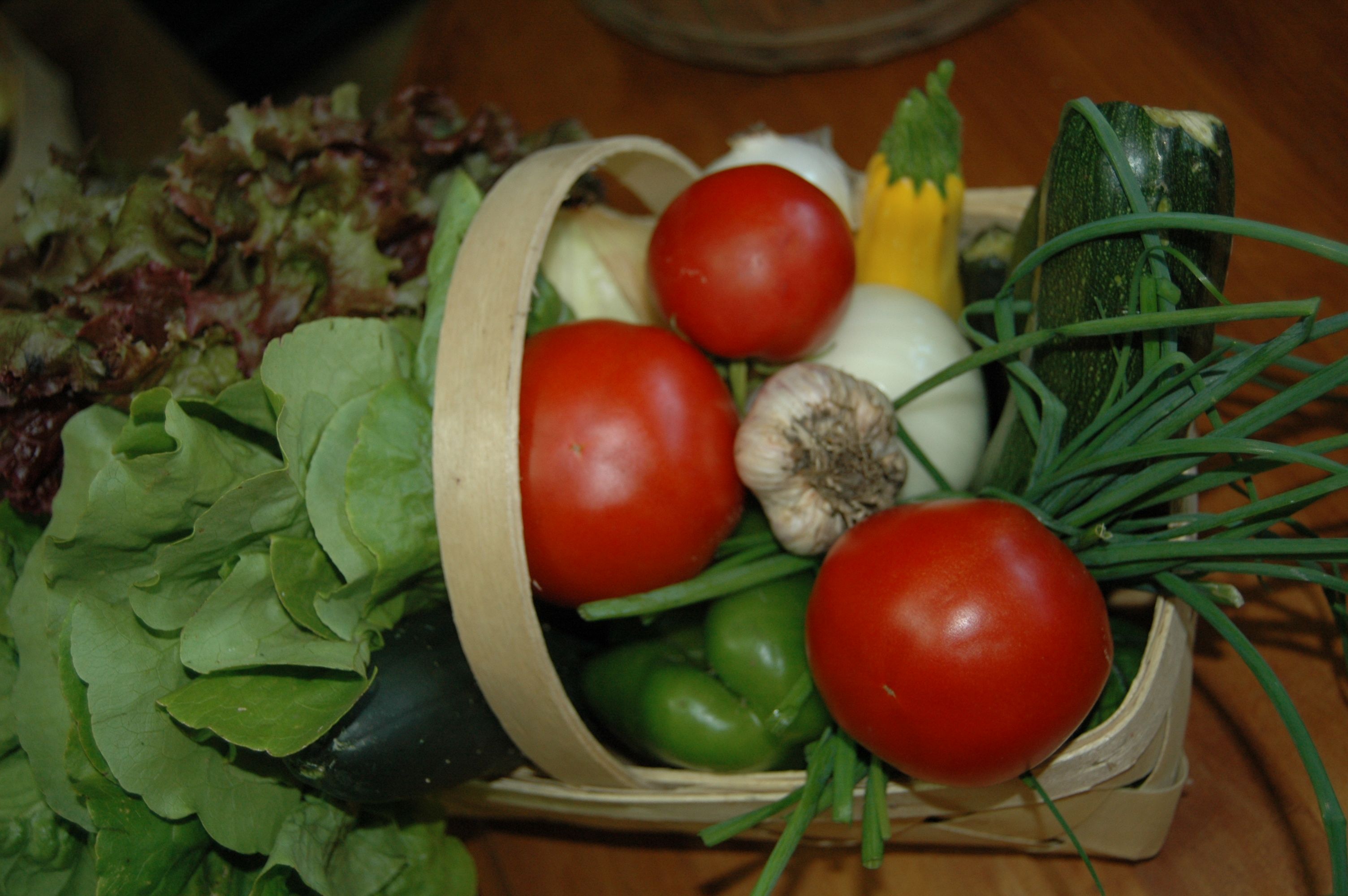
Fresh from the home garden

We bought some apples (a health food right?) at a small market, rather than buying junk food .  Took one bite and had to spit it out… you could taste the chemical coating on the apple.  I don’t know if I’m getting more sensitive or if it’s getting utilized in heavier doses.

I know that I’m reading you can no longer wash the stuff off… it’s absorbed systemically.

Producing your own food, overall it is NOT cheaper;  just a lot, and I mean, a lot better quality.

Quality in value and in taste... and probably even more importantly… not exposed to so much “crud” that is used to produce industrial food (neurotoxins, pesticides, antibiotics, hormones, etc). Upfront it’s not cheaper but we won’t have the same health issues, and as those costs are sky-rocketing, we are saving tons of dollars long-term. Not to mention, just the additional quality of life in not being sick.

Because it's the better choice!

Buy Fresh, Buy Local

OK here’s my spiel: find an organic farmer/market/CSA.  Not because they need it, but because YOU need it, especially your children! Most of this “toxic crappola” did not come on the scene until the 1980’s and has escalated since then. An occasion hit of “crap” our systems can generally detoxify and cope with.

It’s the day in, day out constant onslaught that is creating the epidemic of chronic diseases.

We are working toward becoming a “sustainable” farm, meaning that the farm will provide for our needs in general.  Not everything.  Traditionally one would trade for other services/products. But all the same, farms were not mono-crops.

“Doing” just one thing would exhaust your soil over time, whether crop or a particular livestock.  Just raising corn, just raising pigs would overload you: you would pull out too much of one thing, and dump to much as waste, of one thing, to be healthy.  Farms that did that would eventually exhaust the soil (or contaminate it), people would move on to new territory. The “westward movement” was a significant part of that process with all the “new world” land available.

Think of just eating french fries, or just broccoli, or just chicken. UGGH. That would get old real fast. I think it’s a built in safety mechanism. Your body won’t let you eat just one thing, on purpose. It’s the satiation factor. You know how the first chocolate chip cookie, out of the oven, is heavenly… but by the 4th one you’re starting to feel FULL (OK, so for some of us it’s the 10th cookie)!

home produced

Typically, in the 1800’s, there was the family garden (food raised to be utilized by the family) and then the main crop that would be used for selling (cash trade) and then food raised to be utilized by the livestock.

People often ask why we focus so much on miniature/compact livestock. Mini-horses, mini-cows, & mini-milk cows, in particular. Historically at least one third of a farms products went to feed the livestock.  That means if you had a 3 acre farm (which we basically do), one acre would be in full production just to feed the animals that would provide your power labor such as transportation, pulling a plow, hauling things, or provide meat, milk, butter, cheese, etc. The other two acres are what supported the farm.

Stored hay, for the off season

The problem in the USA is that bigger is better, except when you have to feed it!

Then the food bill goes through the roof, either in terms of producing it (maybe half the acreage would have to feed the livestock instead of one third), or purchasing it.

By downsizing our larger livestock we feel like it is more cost effective in general plus the supporting costs are less. Less fencing, housing, trailer size, pasture damage due to weight, etc.

How much is an acre of land valued in California (an hour north of San Francisco)? An easy $100,000 acre. If we try and feed our livestock from our land… can you imagine covering the cost of $100,000/an acre to produce feed.

Smaller livestock mean lower food needs! We manage much of the cost by importing feed grown on much “cheaper valued” land.  But it used to cost us $5/bale of good feed and now it’s up to $15-20/bale.  In FIVE years.

We americans have been so spoiled in the last 50 years… typically one third of a family’s income in OUR country, went for food.  That dropped to less than 10 percent ! Those “extra” dollars went into buying other things (house, clothes, toys – childrens’ and electronic)! It provided a huge growth factor in our economy… but it was “bought” at great long term personal cost. The economic value of land near a city went through the roof. The farming land itself was turned into strip malls and housing developments.
Be glad you are an american though, as many other countries have reached the point where more than 50% of their income goes to food… if it is to be had.
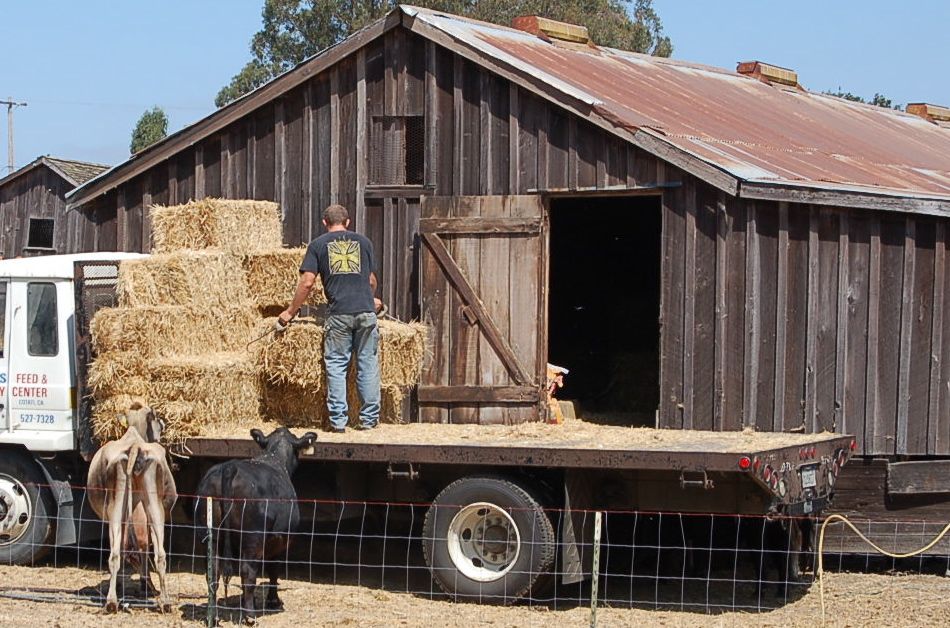
A full load... 120 bales

Moving the Hay

We reached a turning point, as the cost of oil escalates.  Currently we spend about 10 calories (energy, fertilizers, fuel, transportation) to produce ONE calorie of industrial food.

The REAL questions is NOT, “Why is organic food so expensive”,  but “WHY is industrial food so cheap?”  But I don’t think industrial food is going to be “cheap” much longer…

And that “grocery bill” is going to get a heck of a lot more expensive. Cultivate your local farmer… he may be the best value to be had, in the near future!

Calf on the loose – A Subverted Milking session

Chocolate is usually quite amenable to going into the milking trailer, and if she seems to balk a bit… a little shake  of a scoop of grain has her right up to the head stall & feeding trough! Not today… she hemmed hawed up to the entrance, and then backed off.  Her tongue reached out as far as it could to dip into the scoop but no amount of tempting her, would get her to come in.  And then I looked a bit closer. UGGGGH.

milked out

Deflated udder

When one wants to milk the milk cow, it really helps if she has some milk to give! I realized that Chocolate’s calf had been left in the paddock with her, with the morning feed, instead of being left in the main pasture.  We have mom & calf together at night.  At just under 4 weeks I want the calf to be able to nurse during the night and early morning, when it is cold.

Jim does the early morning feeding (ah, what a husband!) before he heads in to work.

Usually, the mom & calf are separated (calf left in the main pasture), and then I milk mid-day, or thereabout. Her udder has filled and there is a “pressure” that needs to be relieved.  Between the grain, high-end hay, and the udder pressure, she is usually very happy to get milked. But not today; in the rush, the calf and mom were together and I’m sure his tummy was quite full ’cause Chocolate’s udders were pretty deflated.

calf on the loose

Calf, tummy full of milk!

Discretion is the better part of valor!

I decided this was one battle I did not need to fight.  But as I was getting Chocolate BACK into the pasture, the calf slipped through the gate, to the outside.  OK… chase the calf, or finish with Chocolate. Whoops, here comes Bessie.

Decided the calf would not go far from mom… so dealt with getting Chocolate back into the pasture. All without Bessie slipping past me… she would LOVE to go to the milking trailer for all those goodies… but she hasn’t delivered yet, so no go. As a standard jersey she was very used to getting grain, in the old days.

So let’s see… here I am, dancing around with three cows trying to get them elsewhere. I just take a deep breath and laugh.  The sun is shining, the momma hen is out with the chicks, and the day is good.

And then…

Under Mick's watchful eye, baby chicks

Phacelia checking out the chicks

My current assistant (10), a young chicken entrepreneur(she has a flock of 9), has stopped by to see what is going on, on the farm.  She volunteers to help me out.

Sad that she doesn’t get to help me with the milking, she is more than happy to help me collect eggs and socialize the calf!

One of the best parts of the farm, letting kids (and adults) have the “experience” of a farm.  Our chickens are free-ranging (oophs, watch where you step!), the mini-horses, and the cows are fair game for interacting with.  Only the hogs are kept contained; one boar and two gilts. (Gilts are female pigs that have never birthed piglets. After they have their first litter they are called a sow.)

But back to the calf… he is having the time of his life running up and down the fence line that separates him from his mom. But oh, what things to explore.  He’s checking out the turkeys, the benches, the chickens, and down to the mini-horses. After 30 minutes of playtime, he’s quite easy to “walk” to the gate.  I barely get it open and he slips through, back to mom.

Phacelia making friends!

Calf socialization in progress

Interestingly, cows have pressure points and if you know the “points” you can move them fairly easily, as long as they are not scared! It’s important to move slow and be MELLOW! You just stand about 45 degrees to the left or right of the REAR of the cow, and move slowly toward them. They will move away, generally in a straight path. How close to the rear of the cow depends on how well they know you.  So the calf is “in training” and he responds very traditionally to the “pressure points” and we are able to walk him to the gate entrance.

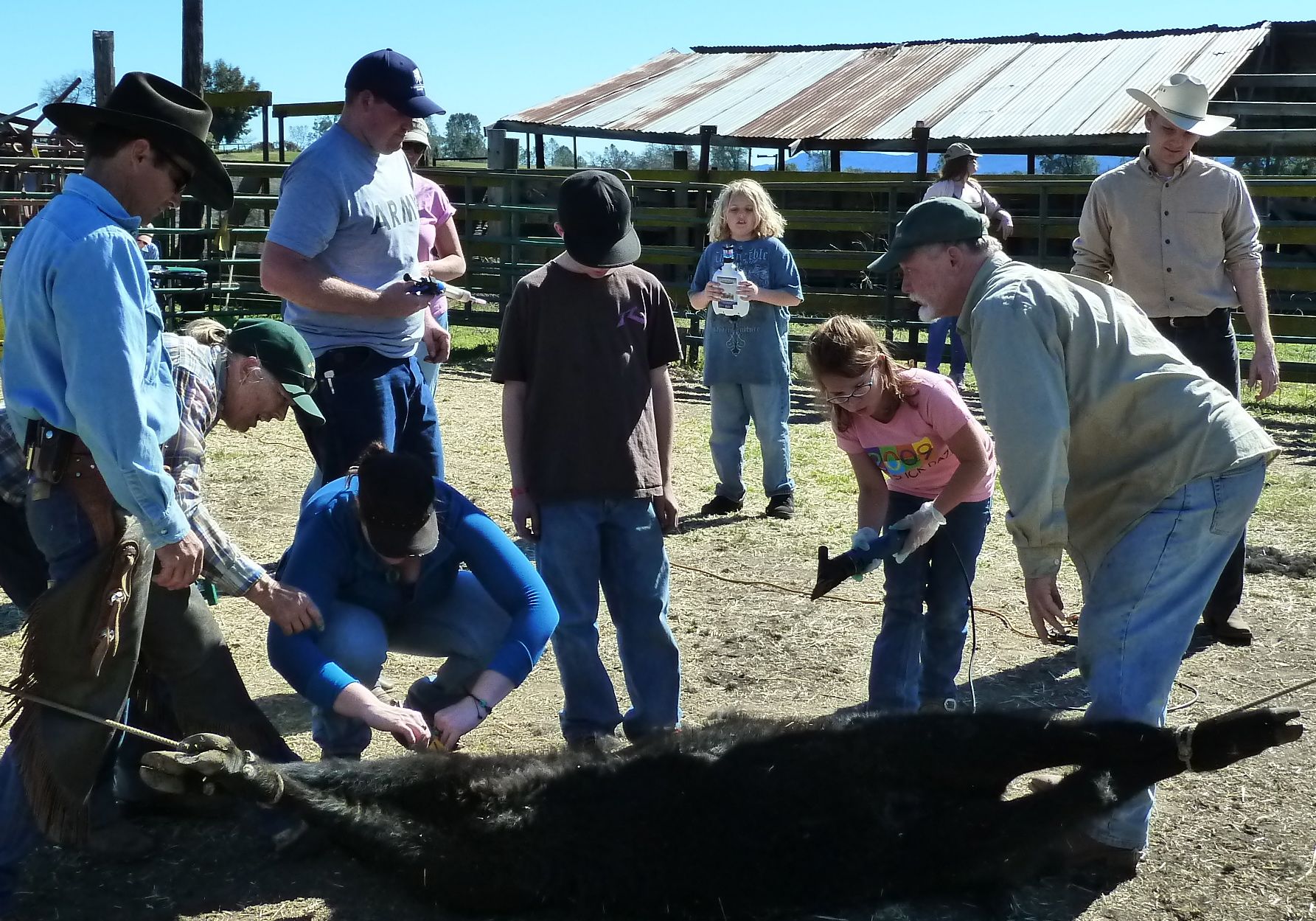
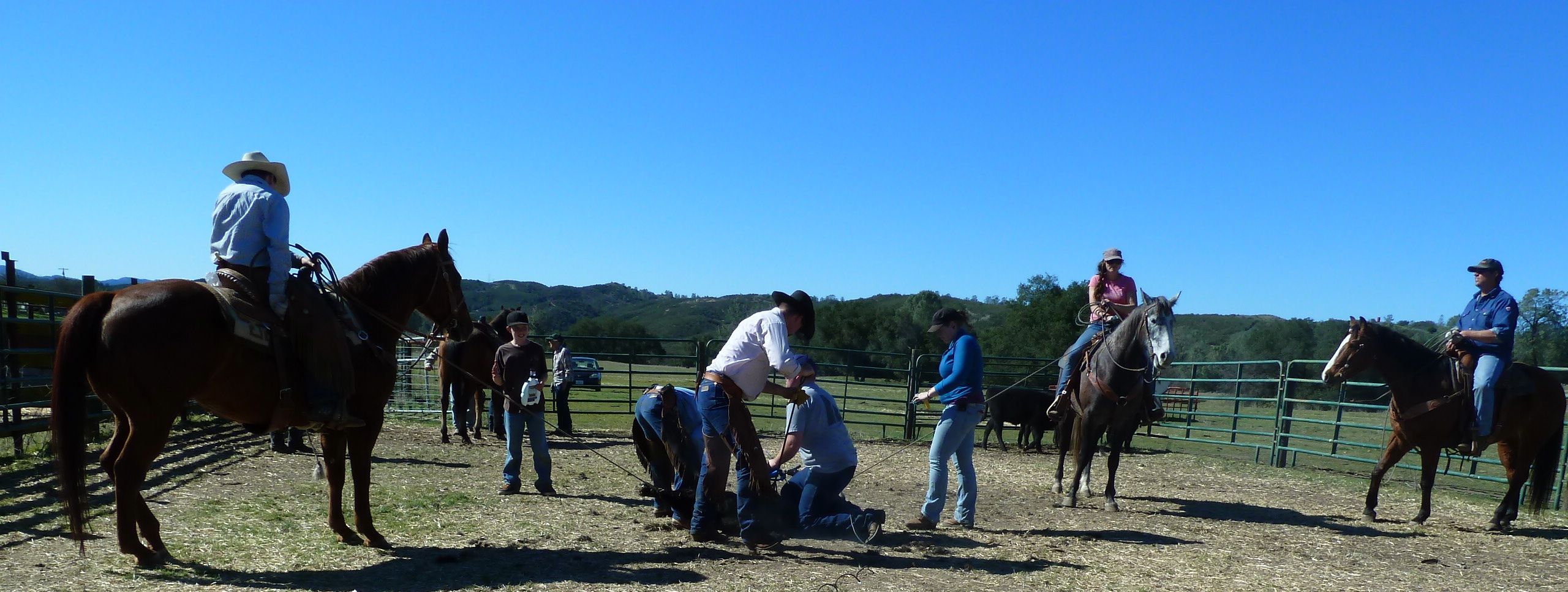
We went on a round-up one time… a real-life cattle roundup, to bring the cow-calf pairs in from the range.  It was time to brand, castrate, vaccinate, etc.  Somewhere in the neighborhood of 30-40 cows.   All the horses were brought out and everyone mounted up (except me… I was helping with the medical supplies) & 92-year-old grandpa, just recovering from heart surgery, was in charge (but NOT allowed back on a horse, yet). He was one tough guy… and quite together! This was his cattle ranch.

kids, adults, all have "jobs"

All hands on board to help out

A 4×4 was sent out with its usual load of hay, which brought the cows into the vicinity.  And then the horses surrounded the cows and moved them into the paddocks. Gates closed… sorting and work began.  James & I just looked at each other. We could have done the same thing, without the horses.  Just pressure walked them into the paddocks. But as someone pointed out… NOT NEAR AS MUCH FUN for all the horsemen (kids, etc). It was a big annual event/party. And the chance to practice roping & cutting skills. The horses were definitely a BIG asset when it came to catching and pinning down the calves.

bringing a calf down

Round-up in action

On our farm, we do things a bit differently.

  • We don’t brand… we ear tag.
  • We don’t vaccinate because our livestock don’t travel (no fairs, shows, etc) so they are not exposed to “bugs”.  If there was something endemic to where we live, we would vaccinate. The horses do get vaccinated for West Nile, spread by mosquitos, which has shown up in our area.
  • To convert bull calf to steers, we band when they are very young.

But we are able to do things this way because we are a very, very small operation. Size changes the methods of operation. Size, numbers, skills, tools at hand, staff, temperament, all factor in.  On each “farm” there is a lot of trial and error, to find the best fit. Farmers and ranchers are real life problem solvers on a daily basis, which of course, makes things quite interesting!

Here on The Heritage Farm, we’re still fine tuning our operation.

This morning, we are a little low on fresh milk and cream… but we had a VERY satisfied calf yesterday, I’m sure! But I’m learning… and fine-tuning our set-up.

Sex on the Farm

It can be difficult to warn people that ours is an “X-rated” farm.  Our farm animals do the “wild thing” at the drop of the hat!  Sex is so prevalent on a farm… and an important topic to be able to discuss.

six piglets getting the colostrum, after birth

Piglets delivered and nursing well

We’ve had many an intern turn red and start stuttering when we have to discuss the topic of breeding and mating.  As if it were magic! Our interns are generally, bright, well-educated young people who want to learn organic farming.  We are one of the few farms that offer livestock management as well as the organic gardening aspect. And yet, SEX, is still a forbidden topic.  But the mating management is critical to the success of any farm.

We try to get over that barrier pretty quickly.  We are involved in utilizing high-tech methods to improve livestock for the small, low-tech farm. We want livestock that can survive WITHOUT vets, medicine, special diets, or extraordinary support.  To do this we sometimes use artificial insemination (A.I.) & embryo transfers (E.T.) to get where we want to go.  Thus it is important to monitor their reproductive cycles.

Lowline Bull, Herd Sire

Lowline Angus Beef, full-bodied, grass-based genetics

We are working on returning to the “grass genetics” that allow livestock to thrive on their historically natural forage.  We use DNA testing to identify markers for food efficiency, as well as observation.  You can have two cows, eating from the same pasture.  One will be fat and the other will look scrawny.  The fat one is better at converting her food to meet her needs AND build a reserve. She is a survivor, and it will cost less to support her.  Her’s are the genes we want in our pool.  As long as she has a good temperament. Temperament trumps… be nice or you are off to freezer camp!

In nature, it make take years for those poor survival genes to be weeded out.  In our herd, we cull those animals and don’t allow them in our gene pool.  We have very mellow animals that are generally easy to work with.

Jim tells the interns, “Cows are really a lot like women! They cycle every 21 days, they get bitchy and they get lovey-dovey.” And it is actually true.  One cow will start licking another, and nuzzling, comforting her. You know she is getting ready to ovulate.  Another cow may bawl and bellow all day.. she is really ready to ovulate. Interns have to learn to watch for standing mount. When a cow allows another cow to mount her, without moving away, we know she is ready to breed! (i.e. she will ovulate within 12 hours).

If you know your cows you can figure out what is going on.  We have to identify when they ovulate so that we can do our intervention (A.I. or embryo transfer), or just mark down on the calendar so we know when to expect a calf if she has been exposed to a bull.  Our goal is to get a bull  & cows, who carry the DNA markers we want to encourage, and then eliminate the need for AI or ET. But at this point the numbers are still small.

The current success rate in embryo transfers, in the industrial cattle industry, is 30-40 %.

Our success rate is close to 90%!

We do NOT use hormone injections or patches to bring on a cow’s cycle. Instead we watch for her natural cycle and work with her.   Of course it helps to have a top-notch vet versed in the skills needed. And we pay close attention to the cows diet.  We add kelp meal, selenium, and diatomaceous earth for the micro-nutrients she may need.

We follow our beef cows, our dairy cows, pigs, and poultry.  The goal is to understand the natural behaviors and work with them to breed stock that can survive in the real world.

Such show-off, our tom turkeys

Heritage Bronze Turkey Toms strutting

I was shocked to hear that the turkey one buys in the store… are so large breasted that they can NO LONGER reproduce on their own.  They must be AI’ed to reproduce.  That, to me, is a very precarious situation.  We use A.I. but our goal is to NOT need it. Our heritage turkeys are quite capable of doing their “job”!

I’m reminded of the story of the special dairy cows in Cuba.  There was a line of dairy cows that were so productive that all the dairies used them.  The problem was… when they no longer had access to the special diet that was needed to produce those prodigious amounts of milk, they were in big trouble.  Besides no longer producing volumes of milk, they could NOT even survive. Not on pasture alone.  That line died out.

We were asked to provide vacation backup for some friends; to milk their daughter’s blue ribbon milking goats.  What struck me as terribly funny (funny sad)… when we milked the goats, we had to pasteurize the milk before we could give it by bottle, to the kids the mother goat had given birth to.  The line was so inbred that an organism was in the milk which could damage the babies if they drank milk straight from the mother.

Our farm is focused on the sustainable. It’s a pretty precarious situation to get into if you make yourself dependent on livestock that can’t survive in the real world

When the price for oil shoots up, the agriculture prices supported by oil must increase.  What happens to the price of food?  We’re working to unhook from that price lock.

Beef has gone up 17% in the last two years, and looks to go higher in the coming years.  The beef herds are the smallest they have been since the 1950’s. Between the price of feed and the lack of water, cattlemen have been unable to support their herds and have reduced their stock.  Our Lowlines don’t need feed (grain), they flourish on forage/grass.

So interns come to our farm and learn about the economics of livestock management… at least on a small family farm. Included in that is learning about the sex life of cows… and most importantly, how to talk about it!

another Lowline Bull

Another Herd Sire

« Older entries Newer entries »